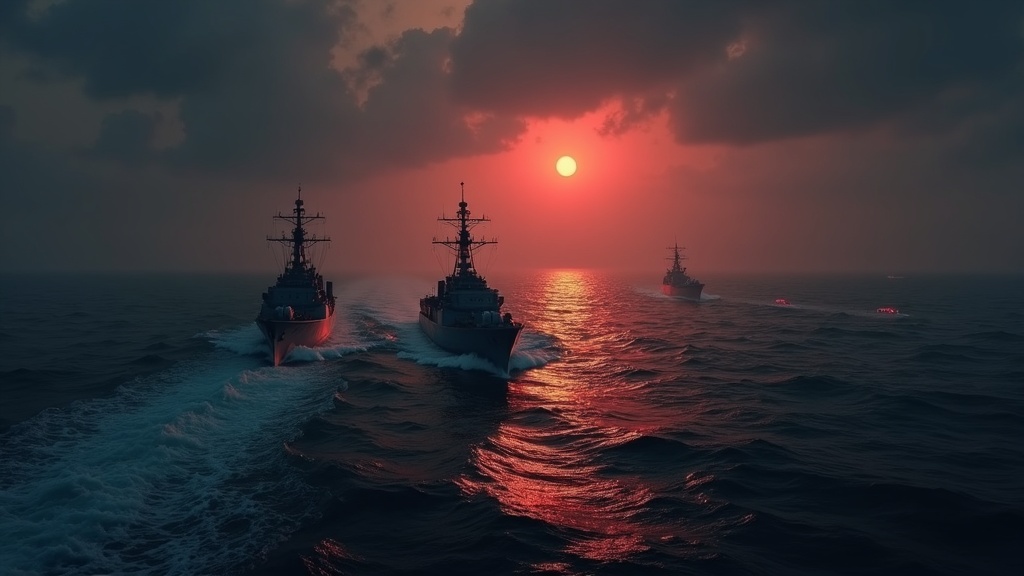
Hormuz Control — Washington and Tehran Both Claim It
On April 11, 2026, US Central Command (the unified combatant command overseeing American military operations in the Middle East) announced that two destroyers, the USS Frank E Peterson and USS Michael Murphy, transited the Strait of Hormuz to clear Iranian sea mines. This is theater, not breakthrough. Iran’s military immediately denied any US vessels entered the waterway, stating that passage authorization remains exclusively in Iranian hands. The Islamic Revolutionary Guard Corps (Iran’s elite paramilitary force controlling the strait) promised a strong response to unauthorized crossings. Maria Sultan, director general of the Pakistan-based South Asian Strategic Stability Institute, told Al Jazeera that free passage without Iranian consent is impossible given Tehran’s tactical control. The dispute erupted during ceasefire talks in Islamabad between US Vice President JD Vance and Iranian parliamentary speaker Mohammad Bagher Ghalibaf — the highest-level direct meeting since Iran’s 1979 revolution. The Strait of Hormuz funnels one-fifth of global oil and gas, plus significant fertilizer shipments. Iran effectively closed it in late February after initial US-Israel strikes, sending fuel prices skyward. For investors: strait reopening remains the core measure of ceasefire success. If Trump cannot secure permanent access, markets will interpret the outcome as strategic failure regardless of military damage inflicted on Iranian forces.
Lebanon Death Toll Passes 2,000 — Ceasefire Scope Still Disputed
On April 11, 2026, Israeli strikes killed at least 18 people across southern Lebanon, pushing the conflict’s total death toll above 2,020 since March 2, according to Lebanon’s Health Ministry. This is escalation under a supposed ceasefire. Eight died near Sidon, 10 in Nabatieh district including three emergency workers. Hezbollah (the Shia militant group and political party backed by Iran) entered the war on March 2 with rocket fire supporting Tehran, triggering Israeli ground invasion and air campaigns. The strikes occurred as Lebanon’s President Joseph Aoun announced direct talks with Israel scheduled for Washington next week. Hezbollah and its ally Amal Movement rejected negotiations outright, calling them unconstitutional. Hundreds protested in Beirut, waving Hezbollah’s yellow flags. Israeli Prime Minister Benjamin Netanyahu declared any Lebanon peace deal must mandate Hezbollah’s disarmament and last for generations. The core dispute: whether the US-Iran ceasefire covers Israeli operations in Lebanon. Tehran claims it secured US guarantees to reduce Beirut strikes. Washington has not confirmed. Al Jazeera correspondent Ali Hashem reported fewer attacks on Beirut’s southern suburbs but no formal announcement. For operators: Lebanon remains a live combat zone. Any supply chains or personnel relying on Beirut port stability should plan for continued disruption through at least mid-2026.
Trump Frames Hormuz Clearing as Favor to Allies Who Refused Help
On April 11, 2026, President Donald Trump posted on Truth Social that the US is clearing the Strait of Hormuz as a favor to countries including South Korea, China, Japan, France, and Germany. This is messaging aimed at domestic voters, not coalition building. Trump wrote that these nations lack the courage or will to secure the waterway themselves, revisiting his frustration that NATO (the 32-nation military alliance) members, South Korea, and Japan declined his requests to send warships for convoy escort missions. South Korea, Japan, and China rely heavily on Middle East energy imports routed through Hormuz. Trump has cited multiple war objectives: dismantling Iran’s nuclear enrichment program, degrading missile capabilities, and encouraging regime change. Six weeks of combat have damaged Iranian military assets but left nuclear facilities and leadership structures intact. Analysts view prolonged conflict as a political liability heading into November 2026 US midterm elections. Trump also claimed all 28 Iranian mine-laying boats now rest at the seafloor, though no independent confirmation exists. He insisted the US holds the upper hand in Islamabad talks, writing that Iran is losing big. For investors: Trump’s public posture suggests willingness to accept a ceasefire that preserves some Iranian leverage if it lets him declare victory before voters head to polls. Watch for asymmetric deals trading Hormuz access for scaled-back nuclear inspections.
Islamabad Talks Hit Snag on Strait Control and War Damages
On April 11, 2026, US and Iranian delegations convened in Islamabad for the first face-to-face ceasefire negotiations since the war began February 28. This is historic diplomacy under collapse risk. Vice President JD Vance led the American side, parliamentary speaker Mohammad Bagher Ghalibaf represented Tehran. Both sides entered with diverging accounts of ceasefire terms. Iran’s semi-official Tasnim News Agency reported that Hormuz control remains a serious disagreement. Tehran argues it must retain leverage over the strait and proposed levying tolls on passage to collect war reparations. Washington calls continued Iranian control a non-starter. Iran also seeks compensation for war damages. The two-week preliminary ceasefire agreed April 8 brought no clarity on frozen Iranian assets, nuclear program limits, or whether Israel’s Lebanon campaign falls within the truce. Al Jazeera’s Kimberly Halkett reported both sides worked late into the night Saturday overcoming a deficit of trust. Trump posted twice insisting Iran does not hold the upper hand, despite Iranian officials publicly claiming exactly that. For capital allocators: the talks’ success hinges on Hormuz reopening. If negotiations collapse, energy price volatility will spike immediately. If they succeed with ambiguous language on strait access, expect drawn-out implementation disputes and episodic disruptions through year-end.
The single variable that matters is Hormuz. Everything else — casualty counts, nuclear inspections, Hezbollah disarmament — flows from who controls the world’s most valuable 21-mile-wide chokepoint. Trump needs permanent reopening to claim victory before midterms. Iran needs leverage to extract reparations and sanctions relief. Both sides are negotiating in public because neither trusts the other to honor private commitments. If you operate supply chains touching Middle East energy, fertilizer, or container shipping, model for three scenarios: full reopening by June, partial access with Iranian tolls through 2027, or talks collapse and renewed closure by May. The Islamabad meetings represent the best chance to avoid the third outcome, but the gap between Washington’s demands and Tehran’s red lines remains wider than either side admits. Position accordingly.
If this was useful, drop a like or comment below. More signal, less noise — every time.

AI Ludens — a creator who works with AI as if it were play.
“Ludens” is Latin for “the one who plays,”
borrowed from Johan Huizinga’s Homo Ludens.
I believe creation alongside AI is meaningful play.
Using n8n, Claude Code, and Google Cloud,
I design and operate content automation pipelines
that grow wiser with every iteration.
I build and run multiple automated media properties,
including worldsignal.site, worldbriefed.world,
and the YouTube channel “500-Year Protocol.”
From publishing to video production,
everything runs as an automated system — built with AI, beside AI.
Each article is reviewed and edited by AI Ludens before publishing to ensure factual accuracy and editorial quality
Leave a Reply