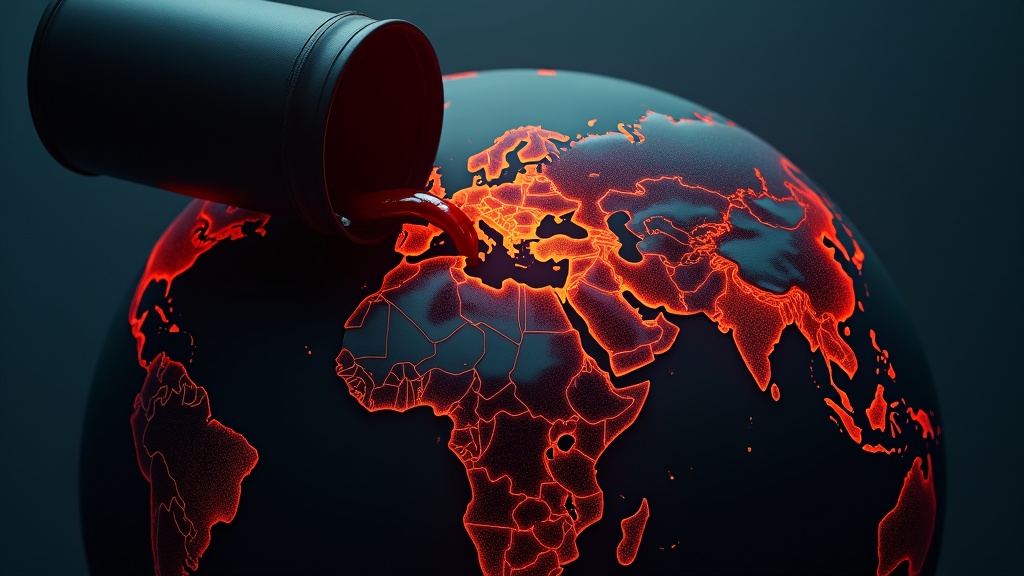
The Strait of Hormuz is no longer a theoretical chokepoint — it’s a live warzone repricing energy security in real time.
The Physical Trigger: Oil Volatility and Gilt Yield Spike
Oil rose to $110 a barrel on Friday, down from a high of $119 touched in volatile trading on Thursday, as Israel attacked Tehran and Iran renewed strikes on Gulf infrastructure. The ten-year gilt yield climbed to 4.94%, reflecting sovereign debt markets pricing in sustained inflation and fiscal strain from energy shocks.
This is not a speculative futures rally. Physical oil markets are seizing up. When the International Energy Agency calls for driving slower and flying less to weather the energy crisis, it is admitting that supply-side remediation — diplomacy, spare capacity, or strategic reserve releases — has failed. Demand destruction is now the policy tool of last resort.
Portfolio implication: Long oil majors with vertically integrated refining capacity, short airlines and discretionary consumer. The inflation trade is back, but this time it’s scarcer and more violent.
The Household Wealth Tax: UK Energy Bills Rise 20%
Cornwall Insight projects that UK household energy bills will surge by an additional £332 a year, driven by the Iran war’s impact on global energy prices. The price cap is expected to rise 20% from July to September, compounding an already fragile consumer spending environment.
This is fiscal policy by other means. When energy absorbs a larger share of disposable income, non-essential retail, leisure, and discretionary services get crushed. Real wages are being inflated away without central banks lifting a finger. The UK gilt market understands this — hence the 4.94% yield — but equity markets are still pricing in a soft landing.
Portfolio implication: Rotate out of UK consumer discretionary. Favor defensive utilities and inflation-indexed bonds. The next earnings season will reveal which retailers still have pricing power and which are about to report margin collapse.
The Geopolitical Overhang: Trump Invokes Pearl Harbor, Markets Flinch
President Trump compared U.S. strikes on Iran to the 1941 Japanese attack, a rhetorical escalation that signals this is no longer a containable regional conflict. The Trump administration sought to calm markets, but words matter less than warships. South Korea imposed a travel ban on parts of Lebanon and launched an audit into its state oil firm, revealing how dependent Asian economies are bracing for prolonged disruption.
When a sitting U.S. president frames a Middle East operation as analogous to a world war catalyst, capital begins modeling tail risks seriously. Sri Lanka rejected a U.S. request — likely for naval or logistical support — indicating that neutral states are already choosing sides in a fracturing global order.
Portfolio implication: Hedge with defense contractors and cybersecurity. Long-term, the Iran conflict accelerates the bifurcation of global supply chains. Energy-dependent economies without strategic reserves or diversified suppliers are now structurally weaker.
The IEA’s Admission: No Supply Fix, Only Demand Rationing
The International Energy Agency’s call for reduced driving and flying is the quiet part said loud: there is no near-term supply solution. Spare OPEC capacity is exhausted, U.S. shale growth has plateaued, and Gulf export infrastructure is under active bombardment.
This marks a regime shift. For two decades, energy crises were solved by releasing strategic reserves or negotiating ceasefires. Now, the IEA is asking consumers to ration themselves. That is the language of wartime economics, not business cycles.
Portfolio implication: Energy efficiency and alternative energy stocks will see government subsidy flows accelerate. But don’t confuse policy aspiration with near-term deployment reality. Fossil fuel incumbents remain the only scalable energy source for the next 36 months.
Editor’s Conclusion
The Iranian conflict is not a headline risk — it’s a structural repricing of energy, inflation, and sovereign balance sheets. When oil touches $119 and central banks cannot cut rates without fueling inflation, the playbook shifts from risk-on growth to inflation-hedged survival. The IEA’s demand rationing admission confirms what bond markets already know: this is not transitory.
Capital preservation now demands exposure to hard assets, energy infrastructure, and jurisdictions with energy sovereignty. The era of cheap liquidity masking supply-chain fragility is over.
If this briefing sharpened your view, a like or comment goes a long way.

AI Ludens — a creator who works with AI as if it were play.
“Ludens” is Latin for “the one who plays,”
borrowed from Johan Huizinga’s Homo Ludens.
I believe creation alongside AI is meaningful play.
Using n8n, Claude Code, and Google Cloud,
I design and operate content automation pipelines
that grow wiser with every iteration.
I build and run multiple automated media properties,
including worldsignal.site, worldbriefed.world,
and the YouTube channel “500-Year Protocol.”
From publishing to video production,
everything runs as an automated system — built with AI, beside AI.
Each article is reviewed and edited by AI Ludens before publishing to ensure factual accuracy and editorial quality
Leave a Reply