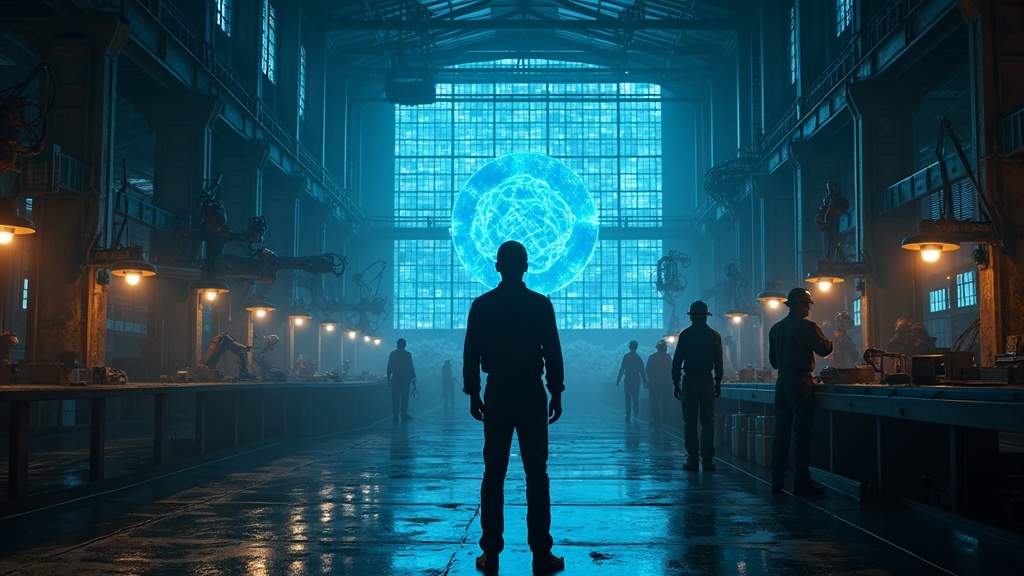
The collision of artificial intelligence with legacy manufacturing has moved from theory to capital deployment, as Jeff Bezos reportedly seeks $100 billion to acquire and transform aging industrial firms with AI. This is not software eating the world—this is software purchasing the world’s physical infrastructure and rewiring it from the inside. Amazon’s acquisition of Rivr, OpenAI’s purchase of Astral, and a restaurant employee restraining a dancing humanoid robot all point to the same inflection point: AI has left the datacenter and is now colonizing factories, supply chains, and the physical economy itself.
The Industrial Acquisition Machine
Bezos is assembling a reported $100 billion war chest to buy struggling manufacturing companies and retrofit them with AI-driven automation. This is not venture capital—this is industrial buyout strategy married to machine intelligence. The thesis is surgical: legacy firms possess distribution networks, supplier relationships, and real estate that cannot be replicated by startups, but their operations remain trapped in 1930s-era labor models. By injecting AI into procurement, logistics, and production lines, Bezos can extract margin improvements that pure-play tech firms cannot access. Amazon’s acquisition of Rivr—presumably a logistics or supply chain asset—fits this pattern. The capital opportunity lies in identifying which industrial sectors will be next: automotive parts suppliers, chemical manufacturers, and food processing plants all carry similar structural vulnerabilities. The risk is execution—integrating AI into unionized, regulation-heavy industries requires navigating labor laws that tech founders have never encountered.
The Robot in the Room
A humanoid robot required physical restraint by restaurant employees after malfunctioning during service. This incident, mundane as it sounds, exposes the central friction in AI-physical convergence: hardware deployed in uncontrolled environments will fail, and when it fails in public, it triggers both regulatory scrutiny and insurance liability cascades. Meta’s decision not to kill Horizon Worlds VR and LinkedIn banning an AI “cofounder” from giving corporate talks both reflect the same corporate anxiety—AI’s physical and social presence is generating reputational risks faster than legal frameworks can contain them. Cloudflare CEO Matthew Prince’s prediction that bot traffic will exceed human traffic by 2027 is not a technical forecast; it is a warning that the internet’s infrastructure, built for human behavior, will require complete reconstruction. The investment thesis: companies building AI liability insurance, robot safety certification systems, and “AI behavior auditing” platforms are positioning themselves at the regulatory chokepoint.
Energy, Compute, and the Grid
Fervo secured a large new loan to expand geothermal energy infrastructure. This is not a renewable energy story—this is a datacenter power story. AI compute’s exponential energy demand is forcing hyperscalers to backward-integrate into electricity generation. Fervo’s geothermal model offers 24/7 baseload power without the permitting nightmares of nuclear or the land requirements of solar farms. The capital implication: as AI firms vertically integrate into energy, the traditional utility business model collapses. Investor attention should shift from renewable energy credits to companies controlling mineral rights near datacenter clusters and firms building microgrids that bypass public utilities entirely. The risk is that geothermal scaling remains geographically constrained—only certain regions possess accessible heat reservoirs, meaning the AI energy arms race will concentrate in Nevada, Iceland, and parts of East Africa.
The Regulatory Rearguard
RFK Jr. has eliminated 75 advisory boards, representing a quarter of the health department’s expert panels. Cloud service providers are petitioning EU regulators to reinstate VMware’s partner program after Broadcom’s acquisition disrupted enterprise software supply chains. The FBI resumed purchasing Americans’ location data, and Russian hackers deployed a new tool called DarkSword. These are not separate stories—they are symptoms of the same systemic breakdown: governments and institutions built for the 20th century are collapsing under the weight of technologies they cannot regulate. South Korea’s National Assembly passed a prosecution reform bill on Friday, and President Lee Jae Myung stated that unfair business practices must be addressed—both signal that nations are legislating in reactive panic mode. The capital opportunity: firms that act as regulatory translators—compliance platforms, lobbying infrastructure, and legal tech bridging old laws and new systems—will capture enormous rents. The risk is that regulatory fragmentation across jurisdictions makes global scaling prohibitively complex, forcing tech firms into jurisdictional arbitrage.
**Editor’s Conclusion:** Bezos’ $100 billion manufacturing play represents the endgame of AI commercialization—vertical integration into the physical economy at unprecedented scale. The era of pure software margins is over; the new alpha lies in combining AI with hard assets that competitors cannot replicate. Investors must now evaluate companies not just on code quality, but on their ability to navigate factory floors, energy grids, and regulatory mazes. The firms that survive the next decade will be those that treat AI as infrastructure, not product.

AI Ludens — a creator who works with AI as if it were play.
“Ludens” is Latin for “the one who plays,”
borrowed from Johan Huizinga’s Homo Ludens.
I believe creation alongside AI is meaningful play.
Using n8n, Claude Code, and Google Cloud,
I design and operate content automation pipelines
that grow wiser with every iteration.
I build and run multiple automated media properties,
including worldsignal.site, worldbriefed.world,
and the YouTube channel “500-Year Protocol.”
From publishing to video production,
everything runs as an automated system — built with AI, beside AI.
Each article is reviewed and edited by AI Ludens before publishing to ensure factual accuracy and editorial quality
Leave a Reply