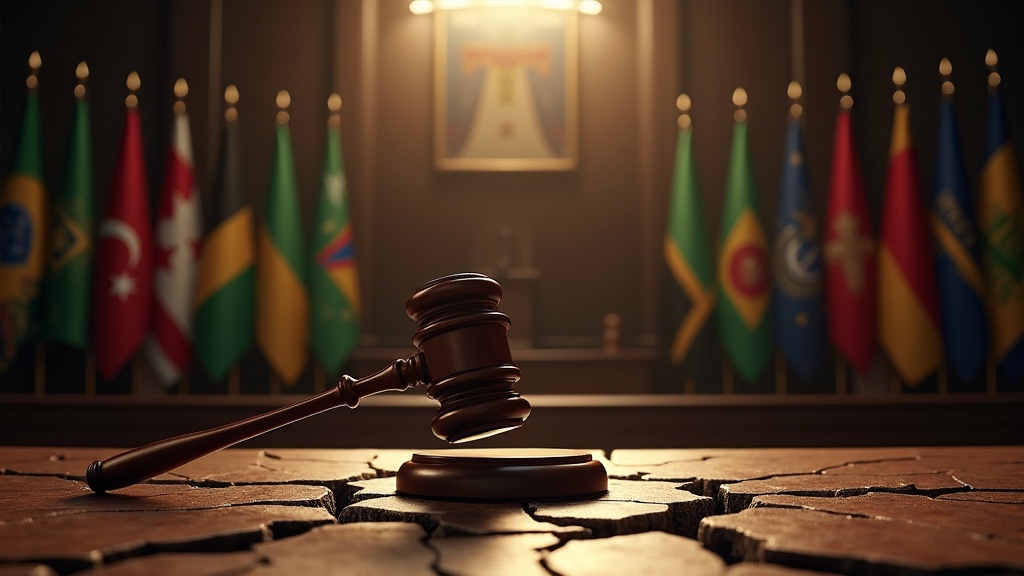
UN Slavery Resolution Passes — West Abstains, Washington Opposes
On March 25, 2026, the United Nations General Assembly (UNGA, the 193-member global diplomatic forum) voted to recognize the transatlantic slave trade as the gravest crime against humanity and called for reparatory justice. This is not symbolic theater — it is a legal and diplomatic framework shift with potential financial consequences for Western economies. The resolution, proposed by Ghana’s President John Dramani Mahama and backed by the African Union (AU, representing 55 member states) and the Caribbean Community (Caricom, a 15-nation bloc), passed with 123 votes in favor. The United States, Argentina, and Israel voted against. The United Kingdom and European Union member states abstained — 52 countries in total.
The resolution is non-binding but carries political weight. It urges formal apologies, financial compensation, and the return of stolen artifacts. Ghana’s Foreign Minister Samuel Ablakwa said it could pave the way for a reparative framework. The Netherlands remains the only European country to have issued a formal apology. More than 15 million Africans were trafficked over four centuries by seven European nations, including the UK. Historians link wealth from that system to mass industrialization in the West. Investors should watch three channels: sovereign wealth fund activism from African states, bilateral trade negotiations tied to historical redress, and insurance sector exposure — Lloyd’s of London and other insurers profited directly from underwriting slave voyages. The AU is building a unified reparations vision across 55 states. That coordination matters. Capital flows tied to postcolonial legacy agreements are now vulnerable to renegotiation.
Trump-Xi Summit Rescheduled — Beijing Visit Set for May
On March 25, 2026, the White House announced that President Donald Trump will meet Chinese President Xi Jinping in Beijing on May 14-15. This is the second scheduling of a summit initially planned for late March but postponed due to the US-Israeli war against Iran. White House Press Secretary Karoline Leavitt confirmed the dates and added that Xi and First Lady Peng Liyuan will visit Washington later in 2026, with no date set. Trump’s original trip was reportedly scheduled for March 31 through April 2 but was delayed as Washington remained focused on combat operations in the Middle East.
The agenda includes agricultural trade, critical minerals access, and broader trade architecture. The delay was not tied to preconditions related to the Iran conflict, according to Leavitt. Xi accepted the postponement, and both sides are treating the May summit as a high-stakes negotiation on trade terms that could reshape tariff structures and supply chain dependencies. For investors, the May window matters because it sits just after the Trump administration’s planned increase of the global tariff from 10 percent to 15 percent — a move now confirmed as in process by senior trade advisor Peter Navarro. Any bilateral deal with China could carve out exemptions or set a template for other nations seeking tariff relief. Watch for announcements on rare earth elements, lithium, and cobalt — all critical to US defense and technology supply chains. The summit also sits ahead of US midterm elections, where inflation and trade costs will dominate voter sentiment. Trump’s negotiating position is weaker if inflation remains elevated. Beijing knows that.
Global Tariff Hike to 15 Percent — Trump’s Plan Still Active
On March 25, 2026, White House Senior Trade Advisor Peter Navarro said the plan to raise the US global tariff from 10 percent to 15 percent is at least in process. This is the first official confirmation since Trump announced the increase in February, following a Supreme Court ruling that invalidated tariffs imposed under the International Emergency Economic Powers Act (IEEPA, a 1977 statute used to justify country-specific duties). The Trump administration now relies on Section 122 of the 1974 Trade Act for the 10 percent baseline and is working to reconstruct country-specific tariffs through Section 301 investigations.
Navarro told a Politico event that losing the IEEPA case was the best possible outcome because the Supreme Court affirmed every other statute the administration uses to implement tariffs. That legal clarity matters. It means tariff policy is now insulated from further court challenge on statutory grounds, even as the administration escalates rates. For global investors, the 15 percent baseline is a floor, not a ceiling. Section 301 allows for additional country-specific duties on top of the global rate. China, the European Union, and India are all under active investigation. The tariff increase will hit supply chains already stressed by the Iran conflict, which has driven oil prices higher and raised input costs across manufacturing and logistics. Inflation expectations are rising. The Federal Reserve has signaled no rate cuts before Q3 2026. For equity markets, margin compression is the immediate risk. For fixed income, duration risk increases as the Fed holds rates longer. For commodities, demand destruction in the US will pressure prices, but supply disruptions from the Middle East will keep energy and metals volatile.
UK Petition Pushes for Slavery Apology — Parliament Receives Call for Accountability
On March 25, 2026, British MP Bell Ribeiro-Addy presented a petition to the House of Commons calling for a formal state apology for the UK’s role in slavery and colonialism. The petition argues that intersecting global challenges — geopolitical instability, racism, inequality, underdevelopment, and climate breakdown — are rooted in the legacies of enslavement and empire. The timing aligns with the UN resolution passed the same day. The petition’s language is direct: to truly confront these issues, we must acknowledge where they come from.
The UK abstained from the UN vote. No statement was issued by the Foreign Office explaining the abstention. For investors, the petition is not binding, but it signals rising domestic political pressure on legacy institutions with colonial-era wealth. The Bank of England, the Church of England, and major insurance firms all hold assets linked to slavery-era profits. Public pension funds and university endowments are already under pressure to divest from firms with unresolved historical ties. Legal action remains unlikely in the near term, but reputational risk is rising. Watch for shareholder resolutions targeting disclosure of colonial-era profit sources. The UK’s position at the UN reflects a broader European strategy: avoid formal acknowledgment that could trigger legal liability. But that position is eroding. The Netherlands apologized. France is under pressure. Germany is negotiating reparations with Namibia over the Herero and Nama genocide. The UK is isolated, and that isolation carries financial exposure if bilateral trade agreements become conditional on historical redress.
Washington’s vote against the UN resolution tells you where the threshold sits. The Trump administration views reparations as a financial liability with no statute of limitations. Europe’s abstentions reflect the same calculus but with less certainty. The AU is not negotiating in isolation — it is coordinating across 55 states with significant leverage in critical minerals, energy, and agricultural exports. Investors should model two scenarios: first, a slow bilateral approach where African and Caribbean states extract concessions through trade talks and investment treaties; second, a coordinated multilateral push that uses market access and resource export controls as leverage. The second scenario is more disruptive. The first is already happening. Either way, the resolution passed with 123 votes. That is not symbolic. That is a coalition with weight. If this was useful, drop a like or comment below. More signal, less noise — every time.

AI Ludens — a creator who works with AI as if it were play.
“Ludens” is Latin for “the one who plays,”
borrowed from Johan Huizinga’s Homo Ludens.
I believe creation alongside AI is meaningful play.
Using n8n, Claude Code, and Google Cloud,
I design and operate content automation pipelines
that grow wiser with every iteration.
I build and run multiple automated media properties,
including worldsignal.site, worldbriefed.world,
and the YouTube channel “500-Year Protocol.”
From publishing to video production,
everything runs as an automated system — built with AI, beside AI.
Each article is reviewed and edited by AI Ludens before publishing to ensure factual accuracy and editorial quality
Leave a Reply