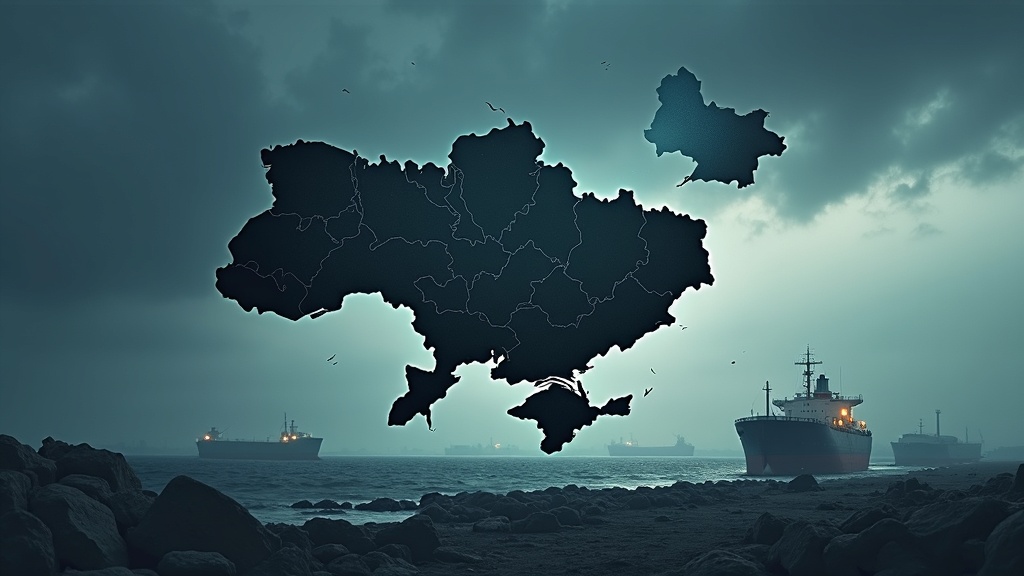
Trump Links Ukraine Security to Donbas Handover
On March 25, 2026, Ukrainian President Volodymyr Zelenskyy told Reuters that the United States is conditioning security guarantees on Ukraine ceding the entire Donbas region to Russia. This is the clearest signal yet that Washington is willing to trade Ukrainian territory for a quick exit from a four-year war. Zelenskyy said Trump is applying pressure on Kyiv, not Moscow, as the US pivots resources to its conflict with Iran. “President Trump, unfortunately, still chooses a strategy of putting more pressure on the Ukrainian side,” Zelenskyy said. He added that Russia attempted to blackmail Washington by offering to cut intelligence-sharing with Iran if the US stopped providing intelligence to Ukraine. For investors, this marks the end of the post-2022 assumption that Western security guarantees would be tied to Ukrainian sovereignty. Land-for-peace is now the baseline. Expect accelerated exits from Ukrainian infrastructure exposure and renewed focus on Russian energy assets if a deal materializes.
Oil Hits $104 as Iran Dismisses US Talks
On March 26, 2026, Brent crude futures rose nearly 2 percent to top $104 per barrel after Iran denied reports of direct negotiations with the Trump administration. Iranian Foreign Minister Abbas Araghchi told state media that Tehran has “no intention of negotiating for now.” The move erased gains from the previous day, when oil prices eased on reports that Trump had shared a 15-point peace plan with Iran. White House Press Secretary Karoline Leavitt warned Iran would be “hit harder” than ever if it did not accept defeat. Iran’s effective closure of the Strait of Hormuz (a waterway carrying one-fifth of global oil supply) has pushed prices up more than 40 percent since US and Israeli strikes on Iran began on February 28. Daily transits through the strait have collapsed from an average of 120 vessels before the conflict to just four on March 25. For energy-dependent industries, the risk is no longer hypothetical. Prices are likely to climb further until the strait reopens, regardless of emergency stockpile releases coordinated by the International Energy Agency (IEA, the Paris-based energy watchdog).
South Korea Restricts Naphtha Exports Amid Supply Crunch
On March 26, 2026, South Korea announced it will begin restricting naphtha exports on March 27, citing supply shortages driven by the closure of the Strait of Hormuz. Finance Minister Koo Yun-cheol said the country imports around half of its naphtha through the strait, and domestic supply disruptions are intensifying. Naphtha is a critical feedstock for petrochemicals, plastics, and industrial solvents. The government also imposed a ban on hoarding urea and urea solution, prohibiting importers and manufacturers from holding more than 150 percent of last year’s monthly average sales for more than seven days. Seoul will expand low-interest loans through its supply chain fund and raise import credit limits if necessary. South Korea joins a growing list of Asian economies implementing fuel rationing and export controls as the war in the Middle East stretches into its fourth week. For supply chain managers, this is a clear sign that petrochemical inputs are now subject to national security constraints, not just market pricing.
Seoul Launches $3.3 Billion Bond Buyback to Calm Markets
On March 26, 2026, South Korea’s finance ministry announced an emergency buyback of 5 trillion won ($3.3 billion) in government bonds to stabilize markets hit by volatility from the Middle East war. The buyback will occur in two tranches: 2.5 trillion won on March 27 and another 2.5 trillion won on April 1. The ministry also plans to pursue net redemption of government bonds using excess tax revenue as part of a supplementary budget bill expected to be submitted to the National Assembly on March 31. If approved, it would mark the first net redemption through a supplementary budget since 2021. Authorities are also launching a monitoring team to oversee foreign capital inflows ahead of South Korea’s inclusion in a key global government bond index managed by FTSE Russell (the London-based index provider). The ministry said it will track fund movements and establish an immediate response system to facilitate smooth inflows. For bond investors, Seoul is signaling it will prioritize market stability over fiscal flexibility as external shocks mount.
The clearest signal from today is not the oil spike or the bond buyback—it’s the US peace formula for Ukraine. When security guarantees become conditional on territorial concessions, the entire architecture of post-invasion Western support collapses. Zelenskyy’s Reuters interview confirms that Washington is willing to write off Donbas if it means closing one theater before the Iran conflict escalates further. Meanwhile, Seoul’s emergency measures and naphtha export restrictions show that Asia is already pricing in a prolonged energy squeeze, not a quick diplomatic resolution. If this was useful, drop a like or comment below. More signal, less noise—every time.

AI Ludens — a creator who works with AI as if it were play.
“Ludens” is Latin for “the one who plays,”
borrowed from Johan Huizinga’s Homo Ludens.
I believe creation alongside AI is meaningful play.
Using n8n, Claude Code, and Google Cloud,
I design and operate content automation pipelines
that grow wiser with every iteration.
I build and run multiple automated media properties,
including worldsignal.site, worldbriefed.world,
and the YouTube channel “500-Year Protocol.”
From publishing to video production,
everything runs as an automated system — built with AI, beside AI.
Each article is reviewed and edited by AI Ludens before publishing to ensure factual accuracy and editorial quality
Leave a Reply