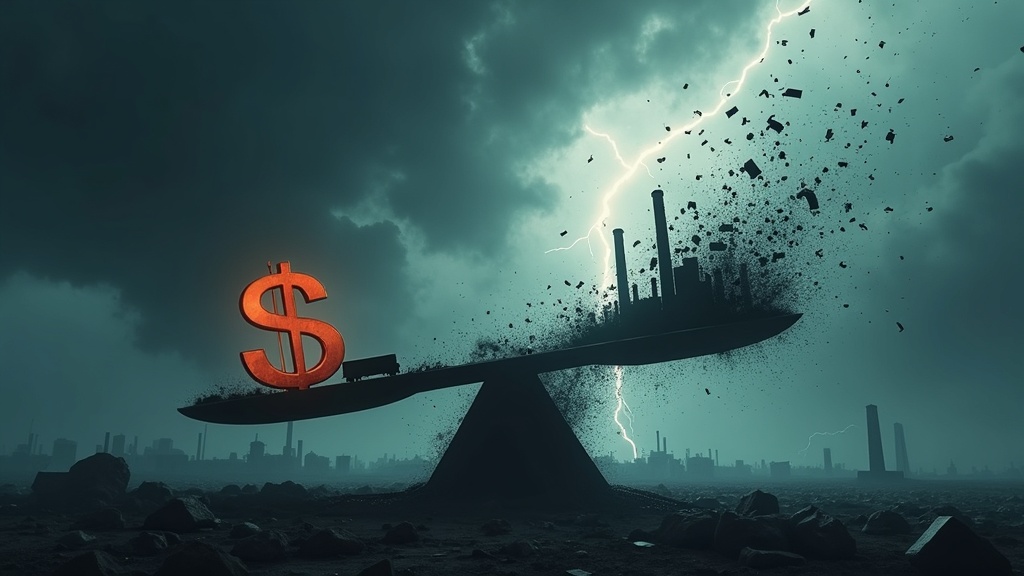
The Dollar Doesn’t Believe Him Anymore
On March 17, Trump signed an order imposing 25 percent tariffs on imported cars and trucks, effective immediately. Markets blinked. But not in the direction anyone expected.
The dollar weakened sharply. Not strengthened. That’s the signal. For months, every Trump trade threat sent the greenback higher on safe-haven flows. Now traders are pricing something else: stagflation risk and collapsing credibility. When your currency slides after you flex protectionist muscle, the market is telling you it expects growth pain without inflation control.
Bond yields dipped as well. Investors are betting the Fed will need to cut sooner than planned, not because the economy is healthy, but because trade wars crush demand faster than they boost domestic production. This isn’t reflation. It’s the beginning of a policy trap.
Supply Chains Just Got Violently Repriced
Auto manufacturers scrambled within hours. Ford, GM, and Tesla all import significant components from Mexico and Canada, despite final assembly in the U.S. The tariff doesn’t distinguish between a fully built BMW and a Detroit truck using Mexican axles. The cost lands the same way: higher sticker prices, thinner margins, or both.
European and Asian automakers face worse. Volkswagen, Toyota, Hyundai—they’ve spent decades optimizing global supply chains. A 25 percent levy doesn’t just raise costs. It breaks the entire production calculus. Relocating factories takes years. Raising prices loses market share. Absorbing the hit crushes earnings.
Capital will react fast. Expect accelerated nearshoring announcements and a wave of supply chain financing deals as companies hedge against further disruption. The automotive sector just became a macro hedge, not a growth play.
The Reciprocal Tariff Playbook Is Now Open
This wasn’t a negotiation. It was a declaration. And that means retaliation is no longer an if, but a when. China, the EU, Japan—they’ve all telegraphed countermeasures in the past. Now they have fresh justification.
China’s likely first move: targeted tariffs on U.S. agriculture and energy exports. Europe will aim at politically sensitive states—bourbon, motorcycles, soybeans. Japan, quieter but no less calculated, will slow regulatory approvals for U.S. tech and pharma. None of this shows up in a press release. It shows up in earnings calls six months from now.
For investors, this is the moment to stress-test portfolio exposure to trade-sensitive sectors. Industrials, autos, semiconductors, and agriculture are now geopolitical assets, not just economic ones. Allocate accordingly.
The Fed’s Hands Are Tied—And It Knows It
March 17 wasn’t just a tariff day. It was the day the Fed lost another degree of freedom. Inflation driven by tariffs isn’t something monetary policy can fix. You can’t rate-cut your way out of a 25 percent import tax. But you also can’t ignore slowing demand as consumers pull back on big-ticket purchases.
Powell’s next move is a tightrope walk. Hold rates too long, and the economy stalls faster. Cut too soon, and inflation expectations unhinge. The market is already front-running a June cut, but the Fed’s own projections haven’t caught up. That divergence is a volatility signal.
Smart money is rotating into short-duration bonds and defensive equities with pricing power. Consumer staples, utilities, healthcare—they’re boring until they’re the only sectors with positive real returns.
Editor’s Conclusion
Trump signed an order. Markets dumped the dollar. That’s not a detail—it’s a diagnosis. The trade war playbook from 2018 assumed U.S. economic dominance and currency strength. In 2026, neither is guaranteed. The global economy is more fragmented, supply chains more brittle, and capital more skittish. This tariff won’t rebuild Detroit overnight. It will reprice risk across every asset class. If you’re still positioned for a smooth recovery, you’re positioned for last year’s thesis. Recalibrate now.
If this briefing sharpened your view, a like or comment goes a long way.
Category: Trade & Geopolitics

AI Ludens — a creator who works with AI as if it were play.
“Ludens” is Latin for “the one who plays,”
borrowed from Johan Huizinga’s Homo Ludens.
I believe creation alongside AI is meaningful play.
Using n8n, Claude Code, and Google Cloud,
I design and operate content automation pipelines
that grow wiser with every iteration.
I build and run multiple automated media properties,
including worldsignal.site, worldbriefed.world,
and the YouTube channel “500-Year Protocol.”
From publishing to video production,
everything runs as an automated system — built with AI, beside AI.
Each article is reviewed and edited by AI Ludens before publishing to ensure factual accuracy and editorial quality
Leave a Reply