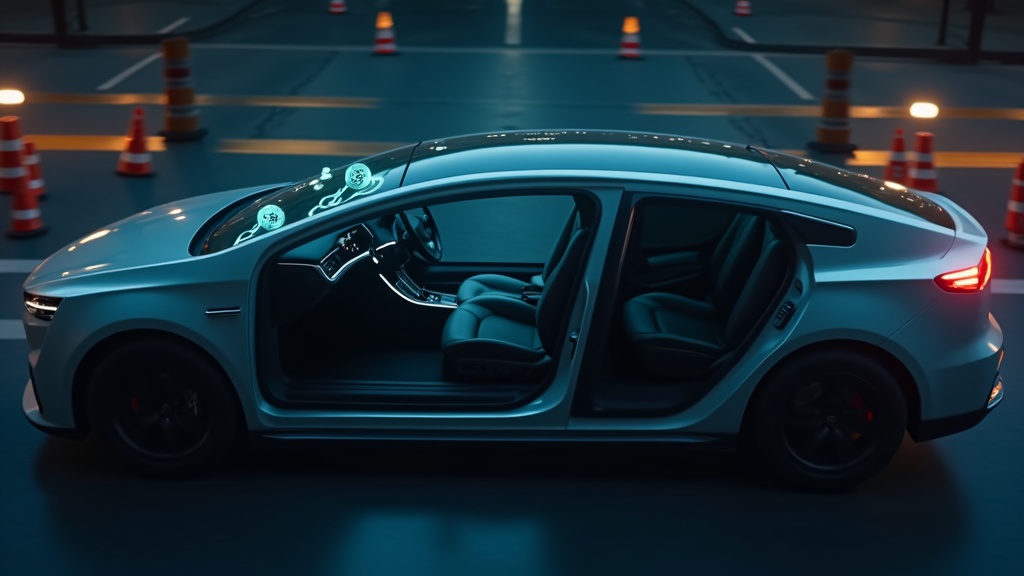
On May 16, 2026, Tesla disclosed that human teleoperators remotely driving its robotaxis crashed the vehicles at least twice since July 2025, according to newly unredacted data submitted to the US National Highway Traffic Safety Administration (NHTSA). Both incidents occurred in Austin, Texas, at low speeds — under 10 mph — with safety monitors in the passenger seats and no paying riders onboard. In one July 2025 crash, a remote operator steered a stopped robotaxi up a curb and into a metal fence at 8 mph, causing minor injuries to the safety monitor. In January 2026, another teleoperator drove straight into a temporary construction barricade at 9 mph, scraping the front-left fender and tire. Tesla, which lacks a public relations team, did not respond to requests for comment.
Tesla allows remote operators to pilot its vehicles under 10 mph to move cars from compromising positions without waiting for field staff or first responders. That makes the company an outlier: Waymo (Alphabet’s self-driving unit operating nearly 4,000 robotaxis across multiple US cities) limits remote driving to 2 mph and says it rarely uses the feature outside training. Other autonomous vehicle operators typically allow remote workers to provide input to the software, which the system can accept or reject — not direct manual control. Safety advocates flag challenges with remote driving in areas with weak cellular coverage or complex street conditions, where operators need a flawless understanding of surroundings to guide vehicles safely.
The disclosures surfaced after Tesla reversed its practice of redacting crash narratives in federal filings. It is unclear why the company changed course this week. The NHTSA database now includes descriptions for all 17 crashes Tesla has recorded since launching its robotaxi network in Austin last year. Most involved other vehicles striking Tesla robotaxis, but at least two included Tesla vehicles clipping mirrors on other cars. In one September 2025 incident, a robotaxi struck a dog that ran into the street; Tesla reported the animal ran away afterward. In another September 2025 crash, a robotaxi made an unprotected left turn into a parking lot and hit a metal chain. A separate September incident saw a robotaxi make contact with a dog and push it into the path of an oncoming van; the dog later appeared behind the van and was seen running away.
PJM Grid Prices Nearly Double — Data Centers Drive the Surge
On May 15, 2026, Monitoring Analytics (an independent market monitor for the PJM Interconnection, which operates the largest wholesale power grid in the US) published a report showing wholesale electricity prices in PJM nearly doubled over the past year. One megawatt-hour now costs $136.53, up from $77.78 at the same time last year. Monitoring Analytics blamed data centers and PJM’s failure to handle surging demand. The monitor warned that price impacts have been very large and are not reversible, and will grow even larger in the near term unless issues associated with data center load are addressed in a timely manner. PJM paused applications for new generating sources in 2022, citing a years-long backlog, and only recently resumed accepting requests. Meanwhile, data center electricity demand has risen dramatically, especially in Northern Virginia, a region thick with data centers.
Monitoring Analytics stated bluntly that without rising demand from data centers, the capacity market would not have seen the same tight supply-demand conditions or the same high prices. Current supply is not adequate to meet demand from large data center loads and will not be adequate in the foreseeable future, the report added. The monitor criticized PJM for lack of transparency and for delaying software upgrades by multiple years with no firm implementation date. The report followed a white paper from PJM that proposed three paths forward, none of which satisfied AEP (a major regional utility that threatened to leave the PJM grid). Monitoring Analytics dismissed PJM’s white paper as using the crisis as a pretext for tearing up the power market’s design, arguing instead that the core market elements remain robust and the source of current issues is data center load.
Ebola Resurfaces in Congo — and Jumps to Uganda
On May 15, 2026, the Africa Centres for Disease Control and Prevention confirmed an Ebola outbreak in the Ituri province of the Democratic Republic of the Congo (DRC), marking the country’s 17th outbreak since the virus was discovered in 1976. The DRC has reported 246 suspected cases and 65 deaths, mainly in the Mongwalu and Rwampara health zones. Uganda subsequently reported one imported confirmed case in Kampala, the capital. Preliminary laboratory results suggest the outbreak is not caused by the Zaire Ebola virus strain, which has been responsible for almost all past DRC outbreaks. Further genetic sequencing is underway. An early Reuters report from Uganda said officials identified the Bundibugyo strain. Jean-Jacques Muyembe (the Congolese virologist who co-discovered Ebola and heads the National Institute for Biomedical Research in Kinshasa) told Reuters that a different strain could complicate responses, since current licensed vaccines and treatments were developed against the Zaire strain.
Africa CDC highlighted complications including the urban context of Bunia and Rwampara, intense mining-related population movement, militia clashes, and gaps in contact tracing. The agency noted potential spillover not just to Uganda but also to South Sudan. Dr. Jean Kaseya, director-general of Africa CDC, said rapid regional coordination is essential given high population movement between affected areas and neighboring countries. The World Health Organization (WHO) received a signal of suspected cases on May 5, 2026, and sent a team to support the DRC health ministry. WHO representatives remain in the DRC assisting outbreak responses. On May 16, 2026, WHO Director-General Tedros Adhanom Ghebreyesus announced the release of $500,000 from WHO’s Contingency Fund for Emergencies to support immediate response efforts. Jay Bhattacharya, heading the US CDC, said the agency’s offices in the DRC and Uganda are offering technical assistance.
Tesla Robotaxis Operate at Fraction of Waymo’s Scale
Tesla’s robotaxi service operates in three Texas cities — Austin, Dallas, and Houston — but runs fewer than 100 vehicles in total, compared to Waymo’s nearly 4,000. Less than half of Tesla’s cars operate without a safety monitor in the passenger seat. Reuters reported this week that service wait times in Houston and Dallas, where robotaxis launched in April, exceed 35 minutes. Even in Austin, where cars have carried passengers for almost a year, robotaxis were sometimes completely unavailable. While Waymo and Zoox (Amazon’s self-driving unit) have reported more crashes than Tesla, they operate at far larger scale. The newly unredacted data may explain why Tesla is scaling its network so slowly. Elon Musk admitted last month that making sure things are completely safe is the biggest limiting factor to Tesla expanding the network, saying the company is being very cautious. Musk has tied his compensation — a potential $1 trillion paycheck by 2035 — to vehicle and robot deliveries, sales of not-yet-released self-driving subscriptions, and the number of robotaxis in commercial operation.
Remote operations are a safety-critical part of autonomous vehicle operations that remains poorly understood. All US self-driving operators maintain remote teams that monitor robot cars and intervene when they get into trouble, according to letters submitted to a US senator earlier this year. But Tesla’s approach stands out for allowing frequent direct remote driving rather than software-mediated input. That raises questions about what teleoperators can see in both coverage and resolution, and what kind of latency they experience while driving, according to Noah Goodall, an independent self-driving vehicle researcher. The two crashes involving Tesla’s remote drivers occurred at speeds below the company’s stated 10 mph limit, yet still resulted in property damage and at least one minor injury. The broader question is whether remote driving at any speed creates risks that outweigh benefits, especially as Tesla ties its CEO’s historic compensation package to robotaxi deployment numbers. For investors, the disclosure gap that just closed matters as much as the crashes themselves — transparency on safety incidents is the floor, not the ceiling, for trust in autonomous operations.
If this was useful, drop a like or comment below. More signal, less noise — every time.

AI Ludens — a creator who works with AI as if it were play.
“Ludens” is Latin for “the one who plays,”
borrowed from Johan Huizinga’s Homo Ludens.
I believe creation alongside AI is meaningful play.
Using n8n, Claude Code, and Google Cloud,
I design and operate content automation pipelines
that grow wiser with every iteration.
I build and run multiple automated media properties,
including worldsignal.site, worldbriefed.world,
and the YouTube channel “500-Year Protocol.”
From publishing to video production,
everything runs as an automated system — built with AI, beside AI.
Each article is reviewed and edited by AI Ludens before publishing to ensure factual accuracy and editorial quality
Leave a Reply