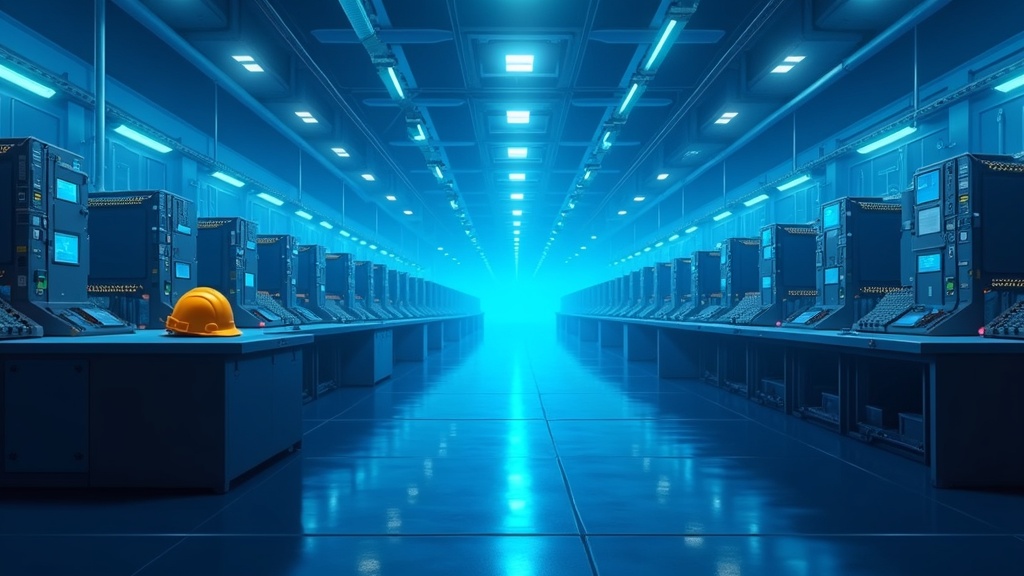
On May 16, 2026, Samsung Electronics (the world’s largest memory chipmaker) agreed to resume government-led mediation talks with its labor union, just three days before a planned 18-day strike set to begin May 20. Over 46,000 workers have signaled willingness to walk out. This is a genuine production risk — not a negotiating tactic.
The dispute centers on performance-based bonuses tied to earnings from the company’s artificial intelligence-related semiconductor business. Memory chips are riding a supercycle driven by AI data center demand, yet labor and management remain sharply divided over how those windfall profits should be shared. Earlier mediation talks at the National Labor Relations Commission (South Korea’s federal labor arbitrator) broke down on May 13.
Samsung Swaps Negotiators — Union Gets Its Way
Samsung replaced its chief negotiator on May 15, installing Yeo Myung-koo, head of the Device Solutions division’s People Team, in place of Vice President Kim Hyung-ro. The union had called for Kim’s removal, citing his lack of understanding of the semiconductor business. Choi Seung-ho, head of Samsung Electronics’ largest labor union, confirmed the change in a notice to members but noted the Monday session’s agenda remains incomplete.
Chairman Lee Jae-yong issued a public apology on May 16 for causing concern over the company’s internal issues and called for unity. Choi responded that employees joined the union because their trust in the company was broken, and rebuilding that trust must be the focus of upcoming talks. The session will take place at the National Labor Relations Commission’s office in Sejong, about 110 kilometers south of Seoul.
Why This Strike Matters Beyond Korea
Samsung supplies roughly 40 percent of global DRAM and a similar share of NAND flash memory. An 18-day stoppage would tighten supply during a period when AI infrastructure builders — hyperscalers like Microsoft, Google, and Amazon — are already competing for capacity. Memory spot prices have climbed steadily since late 2025, and any production disruption would push them higher still.
The union’s membership has swelled as workers watched operating margins expand while bonus structures remained tied to legacy performance metrics. This is not a wage dispute in the traditional sense — it is a fight over how to slice AI-era profits. If Samsung concedes, expect similar demands at SK hynix and Micron within quarters. If it holds firm and production halts, buyers will scramble for alternative supply that does not exist at scale.
Capital Implications — Tight Supply, Higher Prices, Margin Pressure Downstream
Memory prices are set globally, and Samsung’s production footprint is concentrated in South Korea. A strike beginning May 20 would hit output by early June, just as server OEMs finalize third-quarter builds. Contract prices, negotiated quarterly, would reset higher in July — locking in elevated costs for the second half of 2026.
For investors, this creates a split outcome. Memory producers with uninterrupted supply — SK hynix, Micron — capture pricing upside without the labor concessions. Downstream players — server manufacturers, cloud providers, device makers — face margin compression unless they can pass costs through. Equity analysts have already begun stress-testing scenarios where memory input costs rise 15 to 20 percent if the strike proceeds as planned. None of this is priced into consensus estimates yet.
—
The most valuable edge in markets is knowing when consensus assumptions are about to break. Samsung’s labor standoff is that kind of moment — a micro event with macro pricing power. If 46,000 workers walk off the job on May 20, memory supply tightens instantly, contract prices reset higher in July, and every AI infrastructure play gets repriced. Watch Monday’s mediation session. If talks collapse again, reposition before the market does.
If this was useful, drop a like or comment below. More signal, less noise — every time.

AI Ludens — a creator who works with AI as if it were play.
“Ludens” is Latin for “the one who plays,”
borrowed from Johan Huizinga’s Homo Ludens.
I believe creation alongside AI is meaningful play.
Using n8n, Claude Code, and Google Cloud,
I design and operate content automation pipelines
that grow wiser with every iteration.
I build and run multiple automated media properties,
including worldsignal.site, worldbriefed.world,
and the YouTube channel “500-Year Protocol.”
From publishing to video production,
everything runs as an automated system — built with AI, beside AI.
Each article is reviewed and edited by AI Ludens before publishing to ensure factual accuracy and editorial quality
Leave a Reply