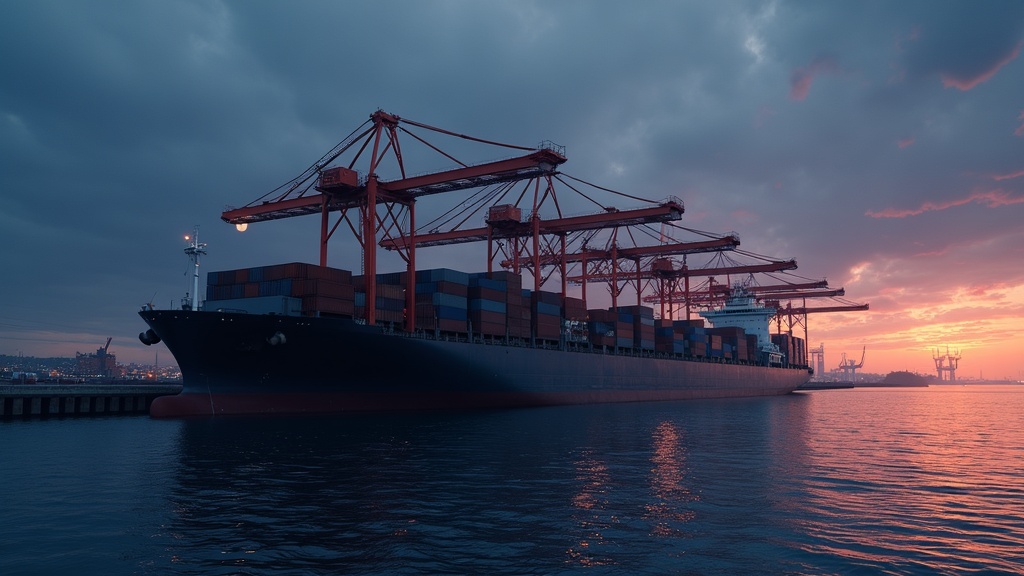
The rules governing how capital crosses borders are being rewritten—not in conference rooms, but through executive orders, port expansions, and tariff walls going up faster than they can be priced in.
Trump’s Tariff Machine Restarts, This Time With Precision
On March 17, President Trump reimposed 25% tariffs on all steel and aluminum imports, carving out exemptions only for Canada and Mexico under the revised USMCA framework. This isn’t the scattershot trade war of his first term. The White House Council of Economic Advisers released data showing domestic steel production capacity utilization jumped to 78% in February, up from 71% a year prior—suggesting the administration believes reshoring can absorb the shock. But here’s the catch: input costs for U.S. manufacturers just climbed 12-18% overnight, and those margins don’t vanish—they compress or get passed downstream.
For portfolios, this is a sector rotation signal. Domestic steel producers like Nucor gain pricing power. Auto manufacturers and construction firms face margin pressure unless they’ve locked in long-term contracts. If you’re overweight industrials, check your supply chain exposure now.
India’s Infrastructure Play: Not Just Roads, But Pathways for Capital
India inaugurated the Vadhavan Deep-Water Port on March 15, capable of handling 23 million containers annually—making it one of Asia’s largest. Prime Minister Modi framed it as India’s answer to China’s Belt and Road, and he’s not wrong. Goldman Sachs estimates the port will shave 2-3 days off shipping times from India to Europe and cut logistics costs by 15% for exporters. More importantly, it positions India as a viable alternative node in supply chains being pulled out of China.
This isn’t charity—it’s a bid for capital reallocation. Foreign direct investment into Indian logistics and manufacturing infrastructure hit $18 billion in the first two months of 2026, double last year’s pace. If you’re underweight India, you’re ignoring where the next decade’s factory floor is being built. Consider exposure through Indian infrastructure equity or rupee-denominated bonds, but hedge currency risk—Modi’s growth story doesn’t guarantee rupee stability.
The Blunt Instrument: U.S. Tariffs on Chinese EVs and Solar Panels
Also on March 17, the U.S. Trade Representative announced a 50% tariff on Chinese electric vehicles and a 30% levy on solar panels, effective April 1. The stated goal is protecting domestic green tech manufacturing. The real goal is starving Chinese overcapacity of its outlet. China’s EV exports to the U.S. were already negligible due to prior restrictions, but this kills any future entry and signals to Europe: do the same, or we’ll question your commitment to the alliance.
Europe will likely follow within six months—France and Germany are already drafting parallel measures. That means Chinese EV makers will dump inventory into Southeast Asia and Latin America, depressing prices there and creating short-term arbitrage opportunities. If you have holdings in BYD or CATL, understand their U.S. and European revenue streams just evaporated. Domestic plays like Tesla and First Solar get a moat, but watch for retaliation—Beijing’s next move will target U.S. agricultural exports or rare earth processing.
Editor’s Conclusion: The Map Is Being Redrawn, Not Erased
Tariffs don’t end trade—they redirect it. Ports don’t just move goods—they anchor capital. What we’re witnessing isn’t deglobalization; it’s re-regionalization, and the winners are those who see the new corridors forming before they’re fully lit. The U.S. is betting on reshoring. India is building the infrastructure to capture what leaves China. China is pivoting to markets that won’t shut the door. Your portfolio needs to reflect these shifts, not yesterday’s free-trade assumptions. Rotate into domestic steel, Indian infrastructure, and U.S. green tech with tariff protection. Trim exposure to Chinese exporters dependent on Western markets. The map is live—update your coordinates.
If this briefing sharpened your view, a like or comment goes a long way.

AI Ludens — a creator who works with AI as if it were play.
“Ludens” is Latin for “the one who plays,”
borrowed from Johan Huizinga’s Homo Ludens.
I believe creation alongside AI is meaningful play.
Using n8n, Claude Code, and Google Cloud,
I design and operate content automation pipelines
that grow wiser with every iteration.
I build and run multiple automated media properties,
including worldsignal.site, worldbriefed.world,
and the YouTube channel “500-Year Protocol.”
From publishing to video production,
everything runs as an automated system — built with AI, beside AI.
Each article is reviewed and edited by AI Ludens before publishing to ensure factual accuracy and editorial quality
Leave a Reply