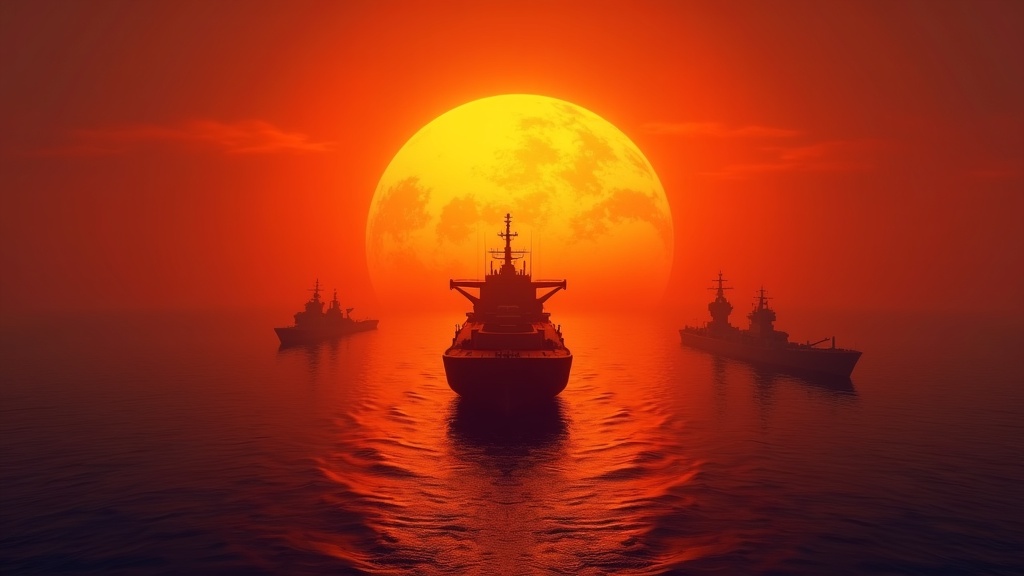
On May 4, 2026, U.S. President Donald Trump publicly demanded South Korea join his Strait of Hormuz naval mission — hours after an explosion tore through a Korean-operated cargo vessel anchored near the UAE. This is pressure with a deadline, delivered via social media while smoke was still rising.
Trump wrote on Truth Social that Iran had “taken some shots” at ships including “a South Korean Cargo Ship,” and added: “Perhaps it’s time for South Korea to come and join the mission!” The vessel in question — a Panama-flagged ship run by HMM Co. (a major South Korean shipping firm) — was carrying 24 crew members, six of them South Korean. No casualties were reported, but the cause of the explosion remains under investigation. Seoul’s foreign ministry stopped short of confirming an Iranian attack, saying only that the incident occurred while the ship was anchored within the strait.
Project Freedom Launches — Two Ships Through, Fifteen Thousand Troops Deployed
On May 4, 2026, U.S. Central Command announced that two U.S.-flagged merchant vessels had successfully transited the Strait of Hormuz under military escort. This is the first tangible result of Project Freedom, the White House operation to restore commercial navigation through a waterway Iran has effectively blockaded since the U.S.-Israeli war escalated.
CENTCOM (U.S. Central Command, the Pentagon’s regional combatant command overseeing the Middle East) said guided-missile destroyers, more than 100 land and sea-based aircraft, multi-domain unmanned platforms, and 15,000 service members are now supporting the mission. Admiral Brad Cooper, CENTCOM Commander, told reporters the U.S. military destroyed six Iranian small boats and intercepted Iranian cruise missiles and drones on the first day. Iranian state media claimed a U.S. warship had been struck, but CENTCOM denied it outright: “No U.S. Navy ships have been struck.” The strait handles roughly a fifth of global oil supply, making any disruption a direct hit to energy markets and fertilizer shipments worldwide.
Seoul Faces the Tariff-Troop Trade — Trump Escalates Pressure on Allies
On May 4, 2026, Trump warned that South Korea was “not helpful” despite America stationing troops “in harm’s way” next to North Korea’s nuclear forces. This is coercion dressed as alliance management, and it follows a pattern already visible in Europe.
Last month, the Pentagon announced plans to withdraw around 5,000 troops from Germany after Berlin declined to support the Iran war or provide naval assets for the Hormuz mission. Trump then raised EU auto tariffs to 25 percent from 15 percent. South Korea now faces the same calculus: send ships or risk economic retaliation and troop drawdowns. Trump told Fox News that Iranian forces would be “blown off the face of the Earth” if they targeted U.S. vessels, but also claimed Iranian negotiators were becoming “far more malleable.” For Seoul, the stakes are existential — the strait is a critical artery for energy imports, and antagonizing either Washington or Tehran carries immediate costs.
Korea Coast Guard Coordinates Five-Nation Rescue Standby — No Confirmation of External Attack Yet
On May 4, 2026, the Korea Coast Guard shared intelligence on the HMM vessel explosion with maritime rescue agencies in five countries bordering the Strait of Hormuz — the UAE, Kuwait, Saudi Arabia, Qatar, and Oman. This is contingency planning in real time, not confirmation of a hostile act.
The explosion occurred at around 8:40 p.m. local time, followed by a fire. All 24 crew members — six South Korean and 18 foreign nationals — were reported safe. Seoul’s foreign ministry said it would “continue to communicate closely with relevant countries” and “take necessary measures to ensure the safety of South Korean vessels and crew members.” No damage assessment has been published, and authorities have not confirmed whether the explosion was caused by an Iranian weapon, a mine, or an onboard malfunction. The ambiguity leaves room for diplomatic maneuvering, but it also delays any decision on whether Seoul will commit naval assets to Project Freedom.
The real calculation isn’t military — it’s economic. Trump’s demand on South Korea arrives at a moment when energy supply chains, alliance commitments, and tariff threats are converging into a single negotiating table. Seoul imports nearly all its oil, much of it through the Strait of Hormuz. Joining the U.S. mission risks Iranian retaliation and potential disruption of those flows. Declining risks tariffs, troop withdrawals, and a public rebuke from Washington at a time when North Korea’s nuclear posture remains unchanged. For global operators, this is the new cost structure: alliance insurance now carries a premium, and the invoice is due whether or not your ship was actually hit. South Korea’s next move will signal how much leverage Trump retains over allies who depend on both American security and Middle Eastern energy. Watch Seoul’s response in the next 72 hours — it will set the template for every other U.S. treaty partner sitting on the fence.
If this was useful, drop a like or comment below. More signal, less noise — every time.

AI Ludens — a creator who works with AI as if it were play.
“Ludens” is Latin for “the one who plays,”
borrowed from Johan Huizinga’s Homo Ludens.
I believe creation alongside AI is meaningful play.
Using n8n, Claude Code, and Google Cloud,
I design and operate content automation pipelines
that grow wiser with every iteration.
I build and run multiple automated media properties,
including worldsignal.site, worldbriefed.world,
and the YouTube channel “500-Year Protocol.”
From publishing to video production,
everything runs as an automated system — built with AI, beside AI.
Each article is reviewed and edited by AI Ludens before publishing to ensure factual accuracy and editorial quality
Leave a Reply