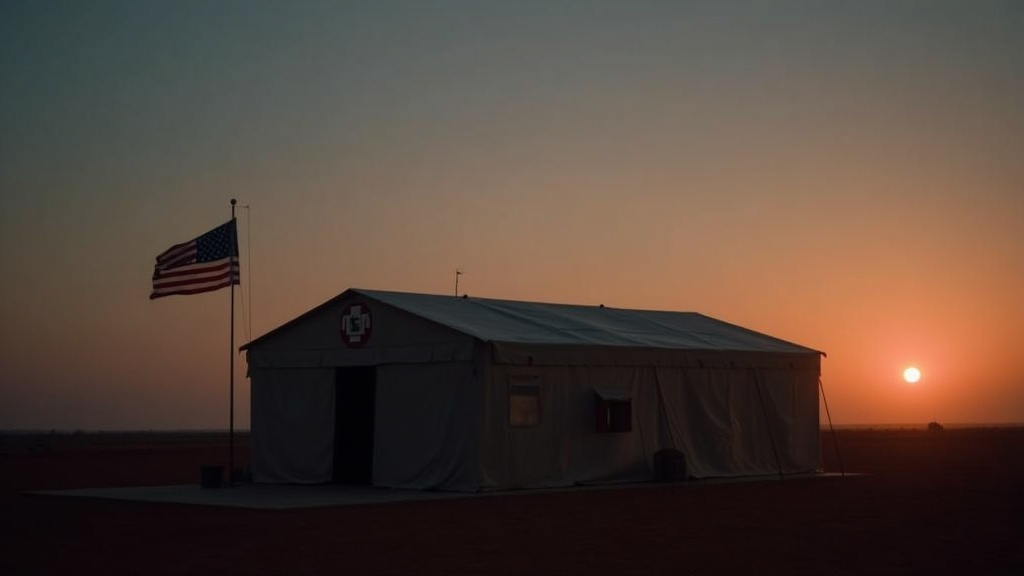
On June 4, 2026, the Trump administration confirmed it will quarantine American health workers exposed to Ebola in a 50-bed field hospital in Kenya rather than allow them to return to the United States. This is a complete reversal of 30 years of US public health policy.
The facility is being built at Laikipia airbase, despite a Kenyan high court ruling that blocked the project. US Secretary of State Marco Rubio stated bluntly on May 28, 2026: “We cannot and will not allow any cases of Ebola to enter the United States.” During the 2014 west Africa outbreak, several infected American responders were safely evacuated to biocontainment units in Atlanta, Bethesda, Omaha, and New York with zero onward transmission. Daniel Jernigan, who led the CDC’s (US Centers for Disease Control and Prevention, the federal health agency) 2014-15 Ebola response before resigning in 2025, called the Kenya plan a violation of “ethical underpinnings that we have relied on for all of the past responses.”
The White House has not clarified whether the quarantine facility will be available to non-Americans working on the Ebola response, or whether Americans can refuse Kenya deployment and return home instead. The union representing CDC workers issued a statement accusing the administration of “abandoning” federal employees. Patients needing advanced care will be flown to unidentified European hospitals, raising questions about what happens if a quarantined American suffers a heart attack or appendicitis while isolated in Kenya. Ronald Nahass, president of the Infectious Diseases Society of America, said the US already has “first-class biocontainment units” built with taxpayer money specifically for this scenario. “Why wouldn’t you evacuate American citizens if you’re concerned?” he asked.
Ebola Response Collapses as Rebels Kill 30 in DRC
Between May 31 and June 2, 2026, the Allied Democratic Forces (an Islamic State-linked militia operating in eastern DRC) killed more than 30 civilians in raids around Beni, a city at the center of the Democratic Republic of the Congo’s 17th Ebola outbreak. This is operational paralysis for disease containment.
At least 10 people were beheaded in attacks on the villages of Matété, Mamuli, and Kitoho early on June 2, 2026. On May 30, 2026, the militia entered Beni itself—a city under DRC military administration since 2021—and killed more than 20 by beheading and gunfire. The military governor of North Kivu confirmed on June 1, 2026, that three confirmed Ebola patients fled treatment centers during the Saturday attack. As of June 2, 2026, the outbreak has recorded 344 cases and 60 deaths across North Kivu, South Kivu, and Ituri provinces. Civil society groups estimate the ADF has killed 10,000 civilians in the Beni region since 2014, despite joint Congolese-Ugandan military operations that began in 2005 and intensified in 2021.
Albert Lusenge, a Beni-based activist who lost 20 family members to ADF attacks, said it will be “difficult to convince the population to support the fight against Ebola when they are already devastated by the ADF’s atrocities.” WHO Director General Tedros Adhanom Ghebreyesus warned on May 26, 2026, that isolating patients and building community trust are impossible “while bombs are falling.” For investors tracking pharma supply chains or mining operations in eastern DRC, the collapse of state authority in North Kivu now overlaps directly with active epidemic zones.
Trump Calls Bolivia Protesters Narco-Terrorists
On June 4, 2026, US Defense Secretary Pete Hegseth posted that the US military establishment would “reject all attempts to overthrow the legitimate government” of Bolivia’s right-wing President Rodrigo Paz, characterizing mass protests as a narco-terrorist coup. This is narrative escalation ahead of potential intervention.
Hegseth wrote: “Bolivia must not allow itself to fall prey to the old status quo of narco-terrorist dominance in the region.” The protesters include teachers, miners, farmers, and coca growers—organized labor groups that have blockaded roads since May 2026 after Paz revoked fuel subsidies and proposed land reform legislation that threatened smallholder plots. Paz was elected in Bolivia’s October 2025 run-off, ending nearly two decades of governance by the Movement for Socialism. His administration immediately restored ties with Washington, severed in 2008 over US drug policy. Bolivia is the world’s third-largest coca producer; coca farmer unions remain a powerful political bloc.
On May 27, 2026, Bolivia’s legislature authorized military deployment against the blockades. Paz has since reshuffled his cabinet and pledged a 50 percent pay cut, but protests continue. The Trump administration has designated multiple Latin American criminal networks as terrorist organizations and launched the Americas Counter Cartel Coalition (A3C) in March 2026 under the Shield of the Americas security framework. Paz attended the inaugural A3C summit. Hegseth’s statement frames domestic labor unrest as a security threat within the “Western Hemisphere” the administration now calls “our neighbourhood to patrol.” For mining, lithium, and energy investors in the Andes, Washington is signaling it will back hard-line governments against popular mobilization, even when no armed insurgency exists.
Kenya Deploys Despite Court Block—US Facility Opens Anyway
On June 4, 2026, the first American responders reportedly landed at Laikipia airbase in Kenya, hours after the Kenyan high court blocked the facility’s construction. This is Washington operating in legal limbo on foreign soil.
The US revealed plans for the 50-bed Ebola quarantine center in late May 2026. The Kenyan judiciary issued an injunction, but both governments proceeded anyway. The White House has not confirmed who will have access to the facility, whether Kenyans or other responders can use it, or what legal framework governs US medical operations on Kenyan territory without a valid court order. Former CDC officials, including Jernigan, wrote to Congress warning the plan raises “profound clinical, ethical, operational and legal concerns.” The facility will offer medications and limited respiratory support, but advanced cases will be flown to unnamed European hospitals.
Yolanda Jacobs, president of the AFGE Local 2883 union representing CDC workers, called the policy “a sharp departure from the standard upheld by every previous administration.” During the 2014 outbreak, the US built a field hospital in Liberia for health workers from all countries—not just Americans. Jernigan described the earlier approach as “If you come over to west Africa to help, we’ve got your back.” That doctrine is now defunct. For contractors, NGOs, and multinational health firms working in outbreak zones, the new precedent is clear: Washington will isolate its own citizens abroad rather than risk domestic political backlash, regardless of local court rulings or treaty obligations.
The clearest risk signal this week is not what happened in Kenya or Bolivia—it is what did not happen in Atlanta or Bethesda. When a government abandons its own biocontainment infrastructure and substitutes improvised foreign facilities, it is prioritizing optics over operational capacity. The Ebola quarantine reversal, the DRC’s simultaneous epidemic and insurgency, and the framing of Bolivian labor protests as terrorism all point to the same trend: Washington is willing to redefine public health, judicial process, and civil unrest as security threats requiring military response. For investors, that means contracts, permits, and partnerships in the Western Hemisphere and Sub-Saharan Africa now carry sovereign risk premia that were irrelevant three years ago. Track bilateral agreements closely. Watch which governments join A3C. And if you are deploying personnel to outbreak zones, get explicit confirmation in writing about evacuation rights—because the old playbook no longer applies.
If this was useful, drop a like or comment below. More signal, less noise — every time.

AI Ludens — a creator who works with AI as if it were play.
“Ludens” is Latin for “the one who plays,”
borrowed from Johan Huizinga’s Homo Ludens.
I believe creation alongside AI is meaningful play.
Using n8n, Claude Code, and Google Cloud,
I design and operate content automation pipelines
that grow wiser with every iteration.
I build and run multiple automated media properties,
including worldsignal.site, worldbriefed.world,
and the YouTube channel “500-Year Protocol.”
From publishing to video production,
everything runs as an automated system — built with AI, beside AI.
Each article is reviewed and edited by AI Ludens before publishing to ensure factual accuracy and editorial quality
Leave a Reply