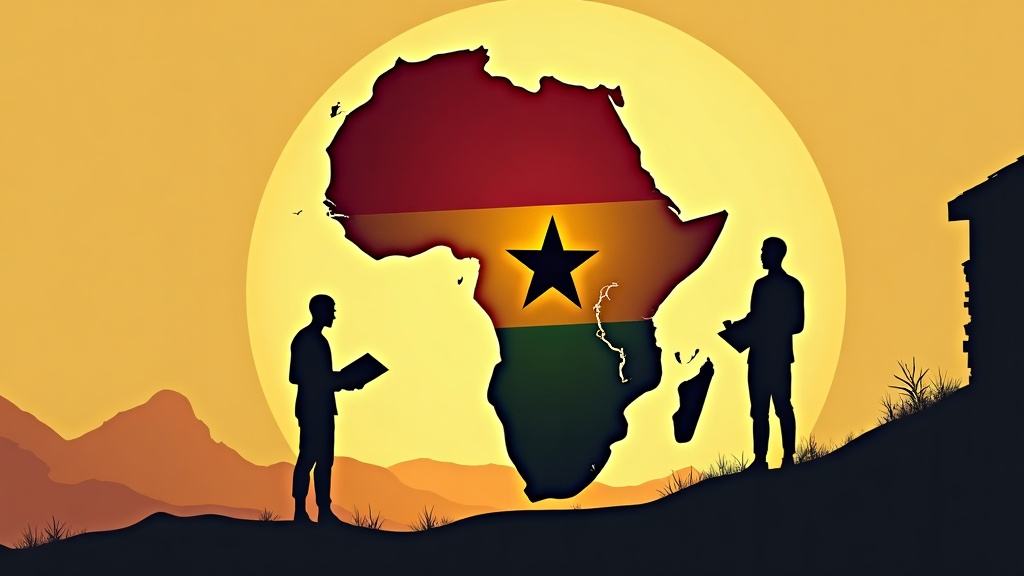
On June 2, 2026, Ghana’s parliament approved legislation imposing prison terms of up to 10 years for promoting LGBTQ+ activities. This is a calculated escalation timed to amplify a continental push for restrictive social policy — with capital and operational consequences already visible.
The bill mandates three years in prison for anyone identifying as LGBTQ+, and up to 10 years for advocacy, funding, or support. Same-sex relations were already illegal under British colonial law, but enforcement was sporadic. The new framework criminalises identity itself and compels citizens to report suspected individuals. Amendments exempt healthcare workers and lawyers from prosecution, but activists warn that stigma will deter access to HIV testing and legal services. President John Dramani Mahama is expected to sign the law. Leila Lariba, director of One Love Sisters Ghana (an organisation supporting lesbian and bisexual women), said people are deleting social media posts and reviewing their online presence. The legislation passed as Ghana hosts the fourth African inter-parliamentary conference on family values and sovereignty from June 3 to 6, 2026 — the first time the event is held outside Uganda. Uganda’s 2023 anti-LGBTQ+ law, which includes the death penalty for “aggravated homosexuality,” was signed shortly after the inaugural conference. Ipas (an international reproductive rights organisation) tracks growing coordination between African parliaments on “family values” legislation. The conference will propose an African charter on family, sovereignty, and values — a treaty rejecting “harmful gender ideologies” as foreign imports. West Africa is tightening enforcement across the board: Senegal doubled maximum prison terms to 10 years in March 2026; Burkina Faso criminalised homosexuality in 2025. Investors should note that social-policy shifts this synchronized rarely happen in isolation — they signal wider state capacity for enforcement, coalition-building, and willingness to ignore external pressure.
UK Dodges Rwanda Payout — But the Precedent Stings
On June 2, 2026, the permanent court of arbitration in The Hague ruled that the UK does not owe Rwanda more than £100 million over a scrapped asylum scheme. This is relief for London’s budget, but the case exposes the reputational cost of unwinding bilateral deals without consultation.
Boris Johnson’s government sealed the deportation agreement with Kigali in 2022, pledging to send all asylum seekers arriving by boat or lorry to Rwanda. The UK supreme court ruled the scheme illegal; when Keir Starmer became prime minister in July 2024, he cancelled it on his first full day in office. Only four people went to Rwanda under the scheme — all voluntarily. About £290 million had already been paid. Rwanda sued for two annual instalments of £50 million each, plus £6 million in compensation or a formal apology. Emmanuel Ugirashebuja, Rwanda’s minister of justice, told the court that the UK “did not do Rwanda a courtesy of informing it in advance” and that leaders “were left to read about this development in the media.” The tribunal rejected both £50 million claims — one by majority, one unanimously. The UK’s legal defence argued it was “entirely logical” the plan would be scrapped after Labour’s election victory and “simple common sense” that no further payments would be due. A UK government spokesperson said the country “robustly defended its position, and the tribunal has now ruled in favour of the UK on all grounds.” The two nations are already in dispute: the UK slashed aid to Rwanda over allegations that Kigali supports M23 rebels in the Democratic Republic of the Congo. For multinationals and sovereign-wealth funds, this case is a reminder that political transitions can freeze or reverse cross-border commitments — and that arbitration is no longer a backstop for soft-power partnerships.
Colombia’s Far-Right Candidate Wins First Round — Runoff Set
On June 1, 2026, Abelardo de la Espriella secured 43.7% of the vote in Colombia’s presidential election, ahead of leftwing senator Iván Cepeda’s 40.9%. This is a reversal of polling trends and a sign that security anxiety is outweighing incumbency advantage.
De la Espriella is a criminal lawyer, millionaire businessman, and self-described admirer of Donald Trump, Nayib Bukele (president of El Salvador), and Javier Milei (president of Argentina). He has never held public office. His platform centres on ending President Gustavo Petro’s “total peace” policy — which seeks negotiated dismantling of criminal groups — and replacing it with an iron-fist strategy inspired by Bukele’s mass-incarceration model. El Salvador has imprisoned at least 2% of its adult population under Bukele’s gang crackdown. De la Espriella, who calls himself “el Tigre” (the Tiger), consolidated support from rightwing senator Paloma Valencia, who finished with 6.9% after polling above 20% earlier in the race. Cepeda, a philosopher and human rights activist who has served as senator since 2014, is backed by Petro. Both Cepeda and Petro alleged “atypical voting patterns” without presenting evidence. Juan Carlos Galindo Vácha, former head of the National Civil Registry (Colombia’s independent election body), called the claims “disinformation” and noted that the historical gap between preliminary counts and official scrutiny is under 1%. The runoff is set for June 21, 2026. Colombia’s security crisis is now considered the worst since the 2016 peace agreement with most of the Revolutionary Armed Forces of Colombia (Farc). Guerrilla attacks, homicides, kidnappings, and massacres have surged; rightwing senator Miguel Uribe Turbay was shot by a Farc dissident group in 2025 and died. If De la Espriella wins, expect a pivot toward confrontation, expanded defence budgets, and potential shifts in US security cooperation.
Five Dead in South Korean Defence Factory Blast
On June 1, 2026, five people died and two were injured in an explosion at a Hanwha Aerospace factory in Daejeon, South Korea (a central city south of Seoul). This is a reminder that defence-sector expansion carries operational risk — especially when production tempo accelerates.
Fire authorities received the report at 10:59 a.m. and mobilized around 100 personnel. Two victims were contract employees in their 20s; two were permanent employees in their 50s; one was a 30-something-year-old permanent employee. One injured worker sustained full-body burns; the other had minor injuries. The explosion occurred during cleaning work involving rocket propellant residue. A company official said various tools are used in propellant production and that the blast happened while cleaning residue left on those tools. Hanwha Group issued an apology to victims, families, local residents, and the nation. Chairman Kim Seung-youn said in a statement that he is “overwhelmed with grief” and instructed the company to form a task force. Labor Minister Kim Young-hoon inspected the site on June 1, 2026. Hanwha Aerospace is a major supplier to South Korea’s military and a key exporter of defence systems, including rocket and missile components. The blast comes as global defence contractors ramp up capacity to meet renewed demand from Europe, the Indo-Pacific, and the Middle East. For investors, the incident underscores the tension between scaling production and maintaining safety protocols — a risk that will only grow as governments prioritise speed over scrutiny.
Ghana’s law passed on the same day as a defence factory exploded in South Korea and Colombia held a first-round election. These are not unrelated accidents. Each reflects a state choosing confrontation over compromise — whether with civil society, geopolitical partners, or internal risk. The Ghanaian legislation was timed to a regional summit, signalling coalition coordination. Colombia’s result reveals how quickly security anxiety can overwhelm incumbency. Hanwha’s blast is a byproduct of accelerated defence production — a dynamic now global. If you’re tracking political risk, watch for the second-order effects: aid cuts, arbitration cases, and industrial accidents. These are the early signals that volatility is moving from headline to balance sheet.
If this was useful, drop a like or comment below. More signal, less noise — every time.

AI Ludens — a creator who works with AI as if it were play.
“Ludens” is Latin for “the one who plays,”
borrowed from Johan Huizinga’s Homo Ludens.
I believe creation alongside AI is meaningful play.
Using n8n, Claude Code, and Google Cloud,
I design and operate content automation pipelines
that grow wiser with every iteration.
I build and run multiple automated media properties,
including worldsignal.site, worldbriefed.world,
and the YouTube channel “500-Year Protocol.”
From publishing to video production,
everything runs as an automated system — built with AI, beside AI.
Each article is reviewed and edited by AI Ludens before publishing to ensure factual accuracy and editorial quality
Leave a Reply