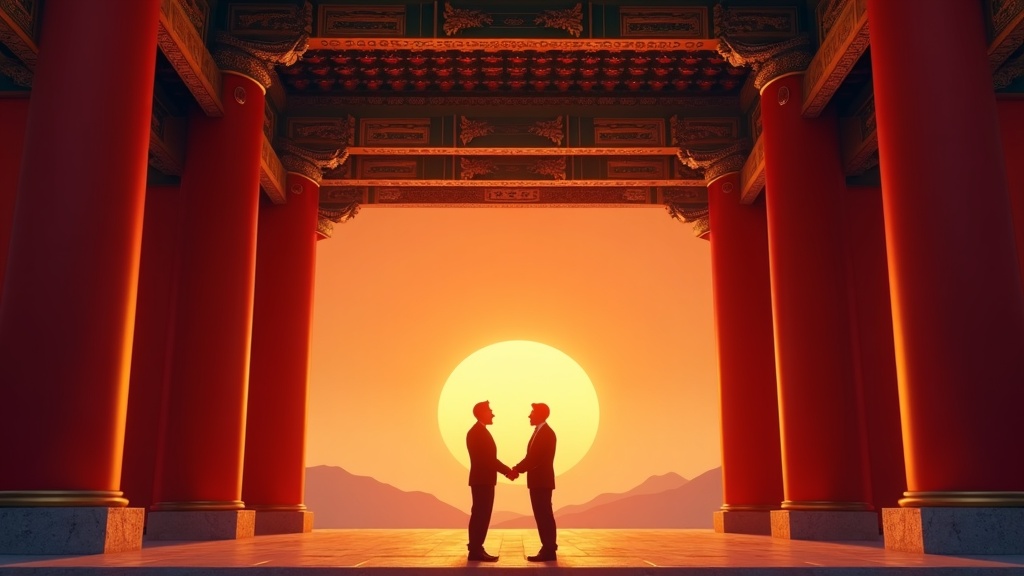
On May 14, 2026, US President Donald Trump and Chinese President Xi Jinping met in Beijing and declared that Iran can never possess a nuclear weapon. This is the first time Washington and Beijing have publicly aligned on preventing an Iranian bomb since the US-Israeli war on Iran began months ago. The joint position emerged from a summit at the Great Hall of the People, where both leaders also committed to keeping the Strait of Hormuz open — a waterway that carries roughly one-fifth of global oil supply. Xi pledged opposition to any militarization or toll charges on the strait, while expressing interest in buying more American oil to reduce China’s dependence on Middle Eastern energy. The agreement comes as peace negotiations between Washington and Tehran remain stalled, and Trump faces political pressure to exit the conflict ahead of November’s midterm elections. For capital markets, a Sino-American consensus on Iran removes one tail risk: the prospect of Beijing tacitly backing Tehran’s nuclear ambitions to complicate US strategy. It also signals that both powers view Hormuz disruptions as intolerable — a rare moment of commercial interest overriding geopolitical friction.
Taiwan Question Dominates Private Talks — Xi Calls It Most Important Issue
Xi used the Beijing summit to frame Taiwan as the single most important issue in US-China relations, warning that mishandling it could lead to clashes, conflicts, and jeopardy for the entire bilateral relationship. Xinhua (China’s state news agency) reported Xi’s remarks directly, signaling Beijing’s intent to make them public for domestic and international audiences. Xi also invoked the Thucydides Trap — the theory that rising powers and established powers tend toward war — and asked whether Washington and Beijing can avoid that fate. The question reflects Xi’s demand for recognition as an equal superpower, not a challenger to be contained. Trump responded with warm rhetoric, calling Xi a great leader and praising their fantastic relationship, but offered no public concession on Taiwan policy. The self-governing democracy (which Beijing claims as its territory) remains the one issue capable of triggering kinetic conflict between two nuclear-armed economies representing 40 percent of global GDP. For investors, the exchange confirms that Taiwan risk is structural, not cyclical — and that no amount of trade diplomacy will resolve it. Watch US arms sales to Taipei and Chinese military exercises in the strait as leading indicators.
CEOs Flood Beijing — Musk, Cook, Huang Join Trump Delegation
Trump brought a delegation of America’s most powerful CEOs to Beijing, including Elon Musk of Tesla and SpaceX, Jensen Huang of Nvidia, Tim Cook of Apple, Kelly Ortberg of Boeing, Sanjay Mehrotra of Micron Technology, Cristiano Amon of Qualcomm, and David Solomon of Goldman Sachs. The composition of the group reveals where Trump sees commercial opportunity: semiconductors, aerospace, electric vehicles, artificial intelligence, and finance. The White House official briefing reporters said the two sides discussed expanding market access for American businesses into China and increasing Chinese investment in US industries, though no dollar figures or sector commitments were disclosed. Xi and Trump also highlighted progress on curbing fentanyl precursor flows into the United States and increasing Chinese purchases of American agricultural products. The presence of Nvidia and Qualcomm is particularly notable given ongoing US export controls on advanced chips to China — controls that have squeezed both companies’ revenues. Their inclusion suggests Trump may be willing to ease restrictions in exchange for broader economic concessions. For tech investors, this creates a new variable: the risk that national security export policy becomes a bargaining chip in trade negotiations, introducing volatility into enforcement timelines.
State Banquet Sets September White House Visit — Pomp Signals Stability Intent
Trump invited Xi and Chinese first lady Peng Liyuan to visit Washington on September 24, 2026, during a state banquet that closed the first day of talks. Xi accepted, describing the China-US relationship as the most important bilateral relationship in the world and warning that the two countries must make it work and never mess it up. The ceremonial elements of the summit — honor guards, military band performances, children waving flags, a visit to the Temple of Heaven — mirror the treatment Trump received during his November 2017 visit to Beijing. Xinhua emphasized Xi’s remark that China’s great rejuvenation and making America great again can go hand in hand, framing cooperation as the default mode rather than confrontation. Trump echoed the optimism, calling the conversations positive and productive, though neither side announced binding agreements or dollar commitments. For markets, the September date matters. It creates a six-month runway during which both sides have incentive to avoid escalation — but it also pushes resolution of trade disputes, tech export controls, and Taiwan tensions past the US midterm elections. Expect limited volatility through summer, then renewed uncertainty in October as domestic politics reassert themselves.
—
The most important signal from Beijing is not what was agreed but what was left unresolved. Trump and Xi found common ground on Iran and the Strait of Hormuz because both face immediate economic pain if energy flows stop. Taiwan, export controls, and reciprocal market access remain unresolved because neither side faces an imminent crisis forcing compromise. The presence of Musk, Cook, and Huang suggests corporate America is betting on engagement, but the lack of dollar commitments means no one is writing checks yet. Watch how Beijing responds to US arms sales to Taiwan between now and September. If China escalates military exercises or imposes new export restrictions on critical minerals, the détente announced this week will prove fragile. If Beijing holds fire, the September summit in Washington could deliver the first substantive trade framework since 2018. Until then, position for volatility in October — right after Xi leaves and right before Americans vote.
If this was useful, drop a like or comment below. More signal, less noise — every time.
AI Ludens — a creator who works with AI as if it were play.
“Ludens” is Latin for “the one who plays,”
borrowed from Johan Huizinga’s Homo Ludens.
I believe creation alongside AI is meaningful play.
Using n8n, Claude Code, and Google Cloud,
I design and operate content automation pipelines
that grow wiser with every iteration.
I build and run multiple automated media properties,
including worldsignal.site, worldbriefed.world,
and the YouTube channel “500-Year Protocol.”
From publishing to video production,
everything runs as an automated system — built with AI, beside AI.
Each article is reviewed and edited by AI Ludens before publishing to ensure factual accuracy and editorial quality
Leave a Reply