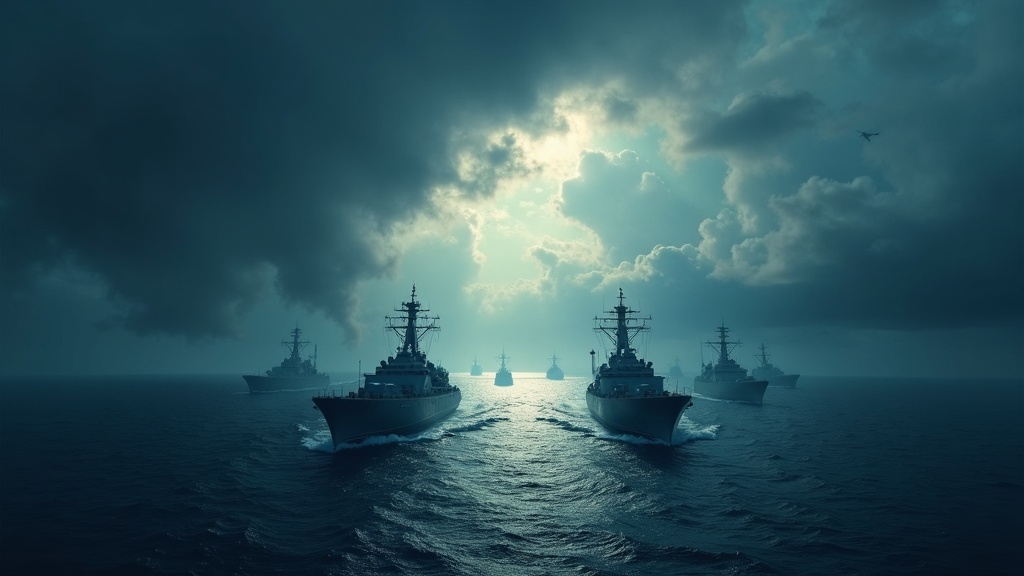
On May 5, 2026, the US Navy launched Project Freedom, a military escort operation designed to force open the Strait of Hormuz after Iran sealed it with threats of mines, drones, and fast-attack craft. This is the first organized attempt to break the blockade since the US-Israeli war on Iran began on February 28, 2026.
US Defense Secretary Pete Hegseth confirmed that two US commercial vessels, escorted by warships, successfully traversed the strait on May 5, 2026. Iran’s Islamic Revolutionary Guard Corps (IRGC—the elite military force separate from Iran’s regular army) denied the crossing and published a new map expanding Iran’s claimed control zone, warning ships outside designated corridors would face a decisive response. Secretary of State Marco Rubio reported 10 civilian sailors dead and seven Iranian fast boats destroyed in the waterway since the conflict began. More than 1,500 vessels with approximately 22,500 crew remain trapped inside the Persian Gulf, according to General Dan Caine, chairman of the US Joint Chiefs of Staff. The strait handles roughly one-fifth of global oil traffic. Insurance premiums for Gulf transits have risen, though exact figures remain unpublished.
South Korea Gets Pressure—and a Warning Shot
On May 5, 2026, President Trump claimed Iran shot at a South Korean-operated cargo ship after it attempted to transit the Strait of Hormuz independently, outside the US-led convoy system. The vessel, operated by HMM Co. (a major South Korean shipping firm), experienced an explosion on May 4, 2026, while anchored off the United Arab Emirates (UAE—a six-emirate federation on the Arabian Peninsula). Seoul has not confirmed Iranian fire as the cause and continues investigating.
Trump stated South Korea imports 43 percent of its energy through the strait and should join Project Freedom. Defense Secretary Hegseth echoed the call, saying the US hopes South Korea, Japan, Australia, and Europe will step up, but Washington will not wait. South Korea has taken no public position on participation. The incident adds capital risk for Korean shippers: operating outside US escorts now carries documented physical danger, but joining a US-led mission could provoke direct Iranian targeting of South Korean assets.
Iran Draws New Borders—US Says They Don’t Exist
On May 5, 2026, Iran’s IRGC released a revised map of the Strait of Hormuz showing expanded Iranian control and designated transit corridors. Ships deviating from these corridors face a decisive response, the IRGC warned. The US rejected the map outright. Defense Secretary Hegseth stated, “They said they control the strait—they do not.”
Iran confirmed firing warning shots at a US warship approaching the strait, forcing it to reverse course. The Pentagon acknowledged the incident but characterized Iranian attacks as below the threshold for resuming major combat operations. Trump dismissed Iran’s military capability, calling its weapons peashooters, and claimed Tehran wants a deal despite public threats. General Caine said the ceasefire, in place since an unspecified earlier date, still holds. The contradiction is stark: both sides claim restraint while exchanging fire and redrawing maps. For commodity traders, the key variable is whether insurance underwriters accept US military assurances or Iranian boundary claims when pricing risk.
Civilian Casualties Mount—UAE Oil Port Hit
On May 5, 2026, Secretary of State Rubio reported 10 civilian sailors dead due to the Strait of Hormuz conflict. Several merchant ships reported explosions or fires on May 4, 2026. The UAE claimed Iran attacked an oil port on May 4, 2026, marking the second consecutive day of strikes on Emirati territory. Iran’s army denied attacking the UAE in recent days.
The UAE hosts Fujairah, a major oil storage and bunkering hub on the Gulf of Oman, outside the Strait of Hormuz but critical to regional energy logistics. Targeting Fujairah signals Iran’s willingness to strike infrastructure beyond the strait’s choke point. Maersk, the Danish shipping conglomerate, confirmed its vessel Alliance Fairfax exited the Gulf under US escort on May 4, 2026, contradicting Iran’s denial of any successful transits. The gap between corporate shipping logs and military claims complicates due diligence. Companies relying on Gulf supply chains now face three risks: direct strike, insurance withdrawal, and conflicting operational intelligence.
The US is trying to impose reality by moving ships through a blockade Iran says does not end. Iran is trying to impose reality by drawing new maps the US says do not exist. Both are correct about the other’s lie, and both are lying about their own position. That is the structure of the Hormuz standoff today. The evidence: 10 dead sailors, 1,500 trapped ships, and Korea caught in the middle without a clear exit. If you operate in energy, shipping, or anything touching Gulf logistics, the next two weeks determine whether insurance markets price this as temporary disruption or permanent re-routing. Watch escort success rates and premium spreads—not Pentagon briefings.
If this was useful, drop a like or comment below. More signal, less noise—every time.

AI Ludens — a creator who works with AI as if it were play.
“Ludens” is Latin for “the one who plays,”
borrowed from Johan Huizinga’s Homo Ludens.
I believe creation alongside AI is meaningful play.
Using n8n, Claude Code, and Google Cloud,
I design and operate content automation pipelines
that grow wiser with every iteration.
I build and run multiple automated media properties,
including worldsignal.site, worldbriefed.world,
and the YouTube channel “500-Year Protocol.”
From publishing to video production,
everything runs as an automated system — built with AI, beside AI.
Each article is reviewed and edited by AI Ludens before publishing to ensure factual accuracy and editorial quality
Leave a Reply