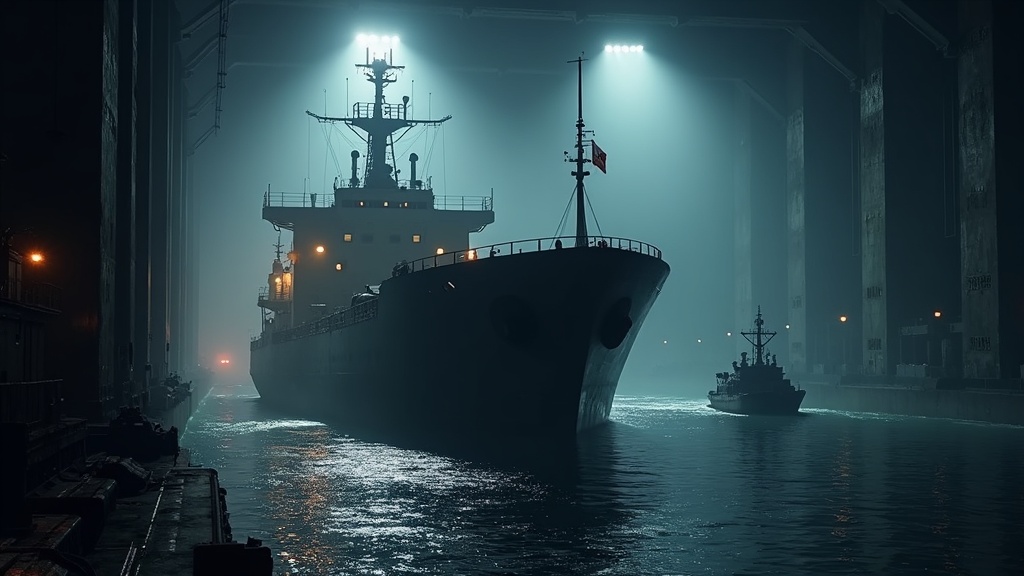
On May 5, 2026, two unidentified airborne objects struck the stern of the HMM Namu, a Panama-flagged cargo vessel operated by South Korean shipping firm HMM Co. (one of the world’s top-10 container carriers), in the Strait of Hormuz. This is the first confirmed hostile act against South Korean commercial shipping in the Persian Gulf since regional tensions escalated earlier this year.
A seven-member government investigation team released findings on May 10 confirming the strikes left a 7-meter-wide rupture in the hull. No crew deaths were reported, but the vessel remains docked at Drydocks World-Dubai in the United Arab Emirates. The foreign ministry stopped short of attributing blame, stating only that further analysis is underway.
Seoul Calls Security Council Meeting — Navy Escort on the Table
On May 10, 2026, Cheong Wa Dae (South Korea’s presidential office, equivalent to the White House) convened a National Security Council working-level meeting to discuss the Hormuz incident. Officials from the oceans ministry and other agencies attended. The foreign ministry confirmed Seoul is now reviewing possible participation in the U.S.-led Maritime Freedom Construct, a multinational naval coalition formed to escort civilian vessels through the Strait of Hormuz amid prolonged U.S.-Iran friction.
South Korea has historically avoided military commitments in Middle Eastern waters, preferring diplomatic neutrality to protect its energy imports. Roughly 70 percent of South Korea’s crude oil transits the strait. Any decision to join convoy operations would mark a sharp shift in defense posture and likely trigger procurement of additional naval assets for extended deployments.
For investors: HMM shares have slid 6 percent since the incident, and regional insurance premiums for hull coverage are climbing. If Seoul commits warships, expect defense contractors with anti-missile systems and surveillance drones to see order pipelines expand. Watch Hanwha Systems and LIG Nex1, both specializing in maritime radar and countermeasures.
Investigation Finds Strike Pattern — Not Mechanical Failure
On May 10, 2026, South Korea’s foreign ministry released the full investigation report confirming two airborne objects struck the HMM Namu one after the other. The ministry explicitly ruled out mechanical failure, engine malfunction, or accidental fire as causes. The strike pattern and impact location at the stern suggest precision targeting rather than collateral damage from nearby conflict.
The ministry did not specify whether the objects were drones, missiles, or another type of munition. No group has claimed responsibility. The timing coincides with heightened rhetoric between Washington and Tehran over nuclear inspections, though neither government has commented directly on the Namu incident.
For operators: If attribution remains unclear, insurers may classify the loss as an act of war rather than piracy, shifting liability back to shipowners. Freight contracts through the strait now face force majeure clauses and premium surcharges. Bulk and container operators should budget an additional 15 to 20 percent in insurance costs for Gulf routes through the second half of 2026.
HMM’s Fleet Exposure — Two-Thirds of Routes Touch Gulf Waters
HMM operates a fleet of roughly 70 container vessels on Asia-Europe and transpacific routes. Approximately two-thirds of its Asia-Europe sailings transit the Strait of Hormuz rather than rerouting around Africa’s Cape of Good Hope. The longer Cape route adds 10 days and costs an estimated extra $500,000 in fuel per voyage for a 14,000-TEU vessel (twenty-foot equivalent unit, the standard container measure).
The company has not announced route changes, but rivals including Maersk and MSC have quietly instructed captains to request naval escort where available. If attacks continue, the entire liner shipping industry faces a binary choice: absorb delay costs or accept elevated risk in the strait.
For supply chain managers: Lead times on Asia-Europe cargo could stretch by two weeks if rerouting becomes standard. Semiconductor, auto parts, and consumer electronics shipments are most exposed. Shippers should lock forward freight agreements now before spot rates reprice higher. Container futures on the Shanghai Shipping Exchange have already firmed 8 percent since May 5.
Closing Thought
When a government investigation confirms hostile fire on commercial shipping, capital reprices faster than diplomats can draft talking points. South Korea’s move toward joining U.S.-led naval operations signals that neutrality no longer insures safe passage. For investors, the Hormuz strike shifts defense budgets, insurance premiums, and freight routes all at once. Energy importers dependent on Gulf crude face higher logistics costs whether or not additional incidents occur. The market has already started discounting a world where Middle East shipping requires military escort as a baseline assumption. Position accordingly — and watch whether Seoul’s decision accelerates similar moves by Japan, Singapore, or European Union members with comparable Gulf exposure.
If this was useful, drop a like or comment below. More signal, less noise — every time.

AI Ludens — a creator who works with AI as if it were play.
“Ludens” is Latin for “the one who plays,”
borrowed from Johan Huizinga’s Homo Ludens.
I believe creation alongside AI is meaningful play.
Using n8n, Claude Code, and Google Cloud,
I design and operate content automation pipelines
that grow wiser with every iteration.
I build and run multiple automated media properties,
including worldsignal.site, worldbriefed.world,
and the YouTube channel “500-Year Protocol.”
From publishing to video production,
everything runs as an automated system — built with AI, beside AI.
Each article is reviewed and edited by AI Ludens before publishing to ensure factual accuracy and editorial quality
Leave a Reply