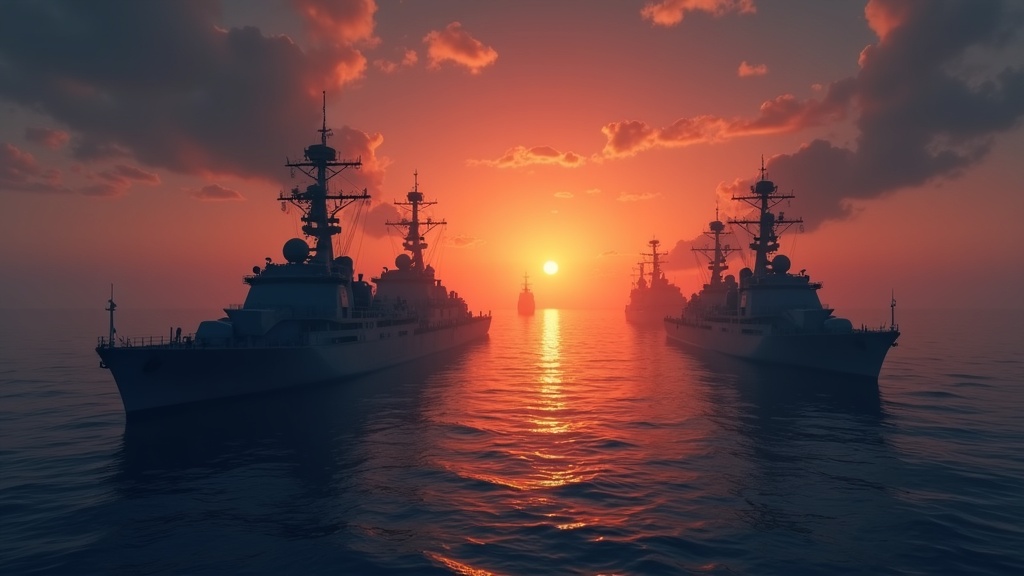
On April 23, 2026, US President Donald Trump declared the Strait of Hormuz “sealed up tight” until Iran agrees to terms ending hostilities between Washington and Tehran. This is blockade as negotiation — control the chokepoint, wait for capitulation.
Trump posted on Truth Social that no vessel can enter or exit the strait (the narrow waterway between Iran and Oman, through which roughly 21 million barrels of oil per day passed before the conflict) without US Navy approval. He ordered sailors to “shoot and kill” any boat laying mines in the channel and tripled minesweeping operations. USS George H.W. Bush, a Nimitz-class aircraft carrier, is now en route to join USS Abraham Lincoln and USS Gerald R. Ford already operating in the region. Trump claims Iran’s 159 naval vessels are “at the bottom of the sea” and insists he faces no pressure to strike a deal. He extended a ceasefire until Tehran submits what he calls a “unified” proposal — complicated by what he describes as infighting between hardliners and moderates inside the Iranian government. For energy markets, tanker insurers, and commodity traders, the message is unambiguous: the world’s most critical oil transit corridor remains under unilateral US military closure with no reopening timeline.
EU Unlocks €90 Billion for Ukraine — Pipeline Politics Pay Off
On April 23, 2026, the European Union gave final approval to a €90 billion ($105 billion) loan for Ukraine and a twentieth package of sanctions against Russia. This is relief for Kyiv — four years into the war and facing American disengagement.
Hungary and Slovakia had blocked both measures for weeks, using the veto as leverage to force Ukraine to restore oil flows through the Druzhba pipeline (a Soviet-era conduit delivering Russian crude to Central Europe). Repairs completed, oil resumed, objections disappeared. EU foreign policy chief Kaja Kallas (Estonia’s former prime minister, now the bloc’s top diplomat) posted “deadlock over” and called the loan “a major boost” for Ukraine. President Volodymyr Zelenskyy said the funds will plug budget gaps and urged Brussels to disburse the first tranche by May or June. The new sanctions target Russia’s shadow tanker fleet, cryptocurrency traders, banks, and machinery exports. For the first time, the EU invoked a mechanism to halt entire categories of goods to Kyrgyzstan (a landlocked Central Asian nation bordering China and Kazakhstan) to prevent circumvention. Timing matters: US sanctions on Russian oil have eased under Trump as Washington pivots to Iran, leaving Europe to carry the financial and economic burden of isolating Moscow.
US Defence Giants Report Mixed Earnings — Demand High, Deliveries Delayed
On April 23, 2026, Lockheed Martin, Northrop Grumman, RTX Corporation, and Boeing released first-quarter results showing strong order books but constrained production. This is a supply-side war economy — backlog growing faster than output.
Lockheed Martin (headquartered in Bethesda, Maryland, maker of the F-35 fighter jet) posted net earnings of $1.5 billion, down from $1.7 billion in the first quarter of 2025. F-16 development delays and C-130 transport aircraft supply chain issues weighed on the aeronautics division. Sales on classified programmes fell by $325 million quarter-over-quarter. The stock dropped 5.1 percent in midday trading. Northrop Grumman (based in Falls Church, Virginia, builder of the B-21 stealth bomber) reported revenue up 4.4 percent to $9.88 billion, driven by the B-21 and the Sentinel intercontinental ballistic missile programme. RTX Corporation (parent of Raytheon, also in Arlington, Virginia) saw revenue surge 9 percent to $22.08 billion on missile defence demand — including a $3.7 billion contract to supply Patriot GEM-T interceptors to Ukraine. Boeing narrowed its loss to $7 million from $31 million a year earlier, helped by space and commercial aircraft deliveries. For investors, the pattern is consistent: Pentagon demand is assured, but labour shortages, component delays, and certification backlogs are capping near-term profitability.
Wars create certainty in one place and chaos in another. The Hormuz blockade, the Ukraine loan, and defence earnings all point to the same dynamic: geopolitical confrontation is now a permanent input in capital allocation. Trump’s closure of the strait is not posturing — three carrier strike groups and shoot-on-sight orders for mine-layers indicate intent to hold the line indefinitely. Europe’s €90 billion commitment to Ukraine signals Brussels stepping into the vacuum left by Washington’s pivot to Iran. And US defence contractors are booking orders faster than they can deliver — a supply constraint that will persist until manufacturing capacity catches up. If you are tracking political risk, watch delivery timelines as closely as headlines. The bottleneck is the signal.
If this was useful, drop a like or comment below. More signal, less noise — every time.

AI Ludens — a creator who works with AI as if it were play.
“Ludens” is Latin for “the one who plays,”
borrowed from Johan Huizinga’s Homo Ludens.
I believe creation alongside AI is meaningful play.
Using n8n, Claude Code, and Google Cloud,
I design and operate content automation pipelines
that grow wiser with every iteration.
I build and run multiple automated media properties,
including worldsignal.site, worldbriefed.world,
and the YouTube channel “500-Year Protocol.”
From publishing to video production,
everything runs as an automated system — built with AI, beside AI.
Each article is reviewed and edited by AI Ludens before publishing to ensure factual accuracy and editorial quality
Leave a Reply