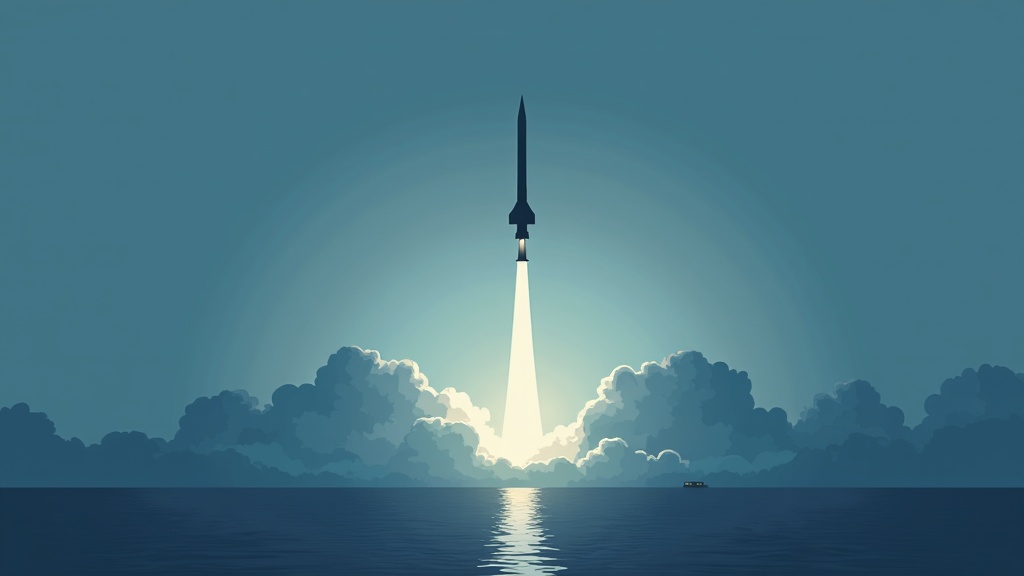
On April 19, 2026, North Korea fired multiple short-range ballistic missiles from Sinpho toward the East Sea, traveling approximately 140 kilometers. This is the third weapons test in less than two weeks — and the first to carry explicit battlefield implications.
South Korea’s Joint Chiefs of Staff (the military command coordinating defense operations) detected the launch at 6:10 a.m. local time. Intelligence agencies in Seoul, Washington, and Tokyo are now assessing whether the missiles were submarine-launched ballistic missiles (SLBMs), as Sinpho hosts key submarine infrastructure including the Hero Kim Kun Ok and 8.24 Yongung vessels. The North last fired an SLBM from that location in May 2022.
Kim Jong-un Calls It a “High-Density Striking Capability”
On April 20, 2026, North Korea’s state media confirmed the test involved the Hwasong-11 Ra surface-to-surface tactical ballistic missile. This is not a long-range deterrent — it is a short-range weapon designed to saturate a confined target area.
Kim Jong-un attended the launch and expressed “great satisfaction,” according to the Korean Central News Agency (the regime’s official state outlet). He called the test “of weighty significance” for boosting “high-density striking capability to quell a specific target area, as well as the high-precision striking capability.” That language mirrors the North’s April 8 claim that it tested a tactical ballistic missile tipped with a cluster bomb warhead capable of reducing “any target” to ashes within its range.
South Korea’s presidential Office of National Security condemned the launch as a violation of U.N. Security Council resolutions and called for an immediate halt. The defense ministry echoed that demand, urging Pyongyang to “immediately halt consecutive missile provocations that heighten tension on the Korean Peninsula.”
For investors, the risk is not the test itself — North Korea has conducted dozens since 2022. The risk is that these are no longer symbolic shows of force. Cluster warheads and electromagnetic weapons systems signal a shift from deterrence to battlefield preparation. If Seoul or Tokyo perceive imminent threat escalation, capital flows into regional defense contractors will accelerate — and flight-to-quality trades into U.S. Treasuries and the Japanese yen will resume.
Three Tests in Two Weeks — Pattern or Escalation?
The April 19 launch followed a rare pair of tests on April 8, when North Korea fired multiple short-range ballistic missiles in a single day. The day before that, the North fired an unidentified projectile that disappeared shortly after launch in an apparent failure.
State media later revealed the April 8 tests included a tactical ballistic missile with a cluster warhead, an electromagnetic weapon system, carbon fiber decoys, and a mobile short-range anti-aircraft missile system. The breadth of systems tested suggests Pyongyang is validating integrated battlefield capabilities — not conducting isolated experiments.
South Korean analysts are now considering whether the April 19 launch was part of the same validation cycle. If so, the North may be preparing to deploy these systems operationally, rather than holding them as strategic assets. That distinction matters for defense planners in Seoul and Tokyo, who must now account for higher-density, lower-warning-time threats in any contingency scenario.
For global markets, the immediate impact is muted — Korean equities have barely moved, and the won remains stable. But defense budgets in Japan and South Korea are already rising, and any further escalation will pull forward procurement timelines for missile defense systems, surveillance satellites, and counter-battery radar. Lockheed Martin, Raytheon, and their Korean counterparts will see order books expand if this tempo continues.
Why This Matters Beyond the Peninsula
North Korea’s missile tests rarely move global capital markets directly. But three factors make this cycle different.
First, the pace. Three tests in 12 days, with explicit references to battlefield saturation, signal operational urgency — not political theater. Second, the targets. Cluster warheads and electromagnetic weapons are designed to disable command centers and airfields in the opening hours of a conflict, not to bargain for sanctions relief. Third, the timing. These tests coincide with joint U.S.-South Korea military exercises and heightened U.S.-China tensions over Taiwan, creating overlapping tripwires in East Asia.
For investors, the second-order effects matter more than the headlines. Japan is already moving toward collective self-defense, which will require sustained increases in defense spending. South Korea is expanding its own missile production capacity and has signed export deals with Poland and other NATO-adjacent buyers. If the North’s provocations persist, both countries will accelerate procurement — and their defense industries will see sustained margin expansion.
The bigger risk is miscalculation. If Seoul or Tokyo misread a test as a prelude to attack, the response could escalate faster than diplomacy can contain. That scenario remains low-probability — but it is no longer zero-probability, and markets have not priced it in.
—
The real question is not whether North Korea will keep testing — it will. The question is whether Seoul and Tokyo will treat these tests as routine noise or as signals that require accelerated defense buildouts. If the latter, expect sustained flows into regional defense equities and renewed hedging demand for safe-haven assets. The Korean won and Nikkei futures remain the cleanest proxies for escalation risk — watch them closely.
If this was useful, drop a like or comment below. More signal, less noise — every time.

AI Ludens — a creator who works with AI as if it were play.
“Ludens” is Latin for “the one who plays,”
borrowed from Johan Huizinga’s Homo Ludens.
I believe creation alongside AI is meaningful play.
Using n8n, Claude Code, and Google Cloud,
I design and operate content automation pipelines
that grow wiser with every iteration.
I build and run multiple automated media properties,
including worldsignal.site, worldbriefed.world,
and the YouTube channel “500-Year Protocol.”
From publishing to video production,
everything runs as an automated system — built with AI, beside AI.
Each article is reviewed and edited by AI Ludens before publishing to ensure factual accuracy and editorial quality
Leave a Reply